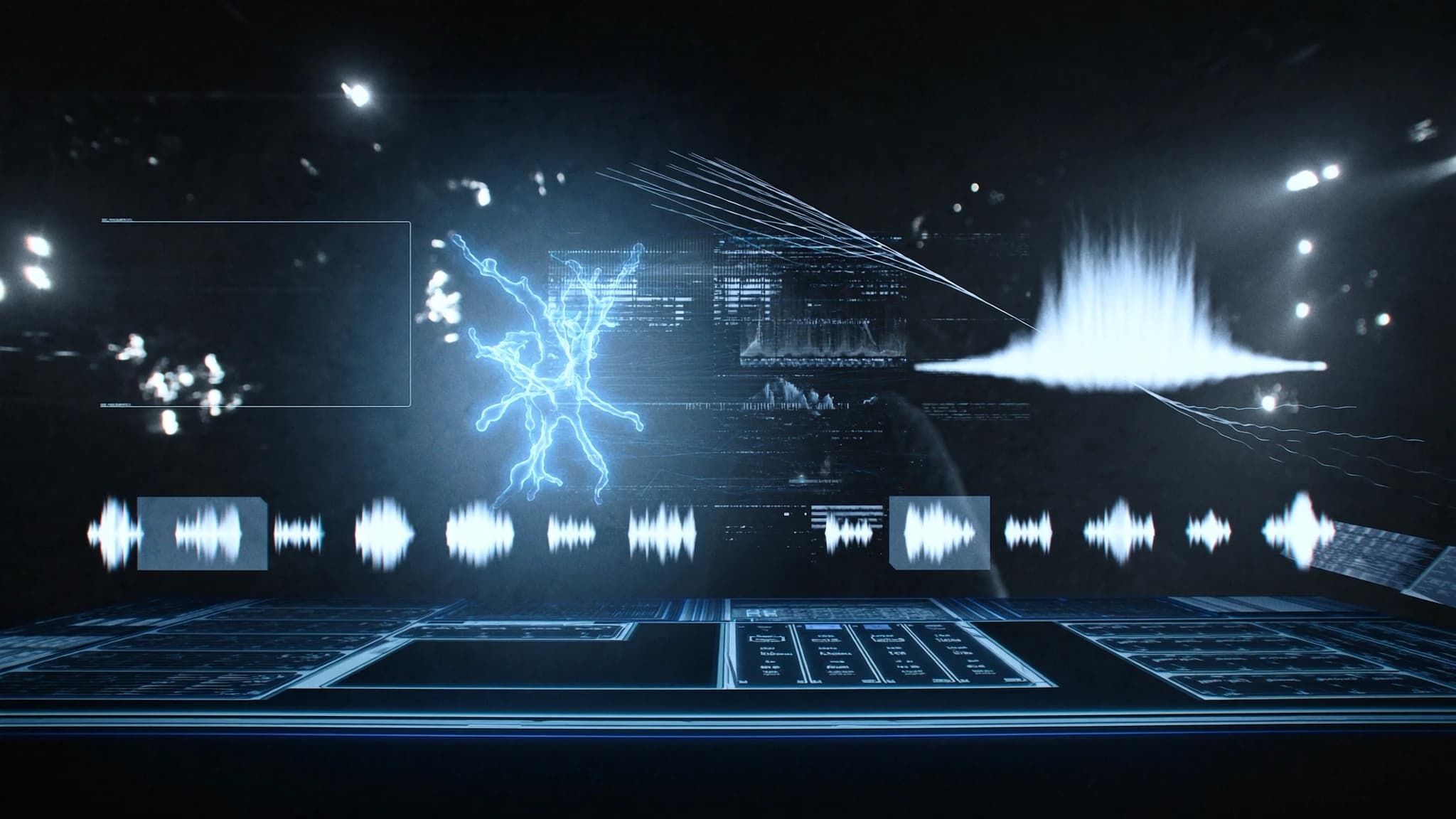
AI Real-Time Source Separation and Stems

Real-time AI source separation is transforming live sound by enabling on-the-fly extraction of vocals, instruments, and other elements from a mixed audio feed. This technology opens new possibilities for live remixing, personalised in-ear monitor (IEM) mixes, and broadcast applications, but it also comes with significant technical and practical limitations. SSOUNDS engineers are actively exploring how these tools integrate with professional PA systems to enhance flexibility without compromising audio quality.
Key takeaways
- Real-time AI source separation uses deep neural networks to extract stems from a mixed audio feed with low latency.
- Applications include live remixing, personalised IEM mixes, and broadcast audio processing.
- Current limitations include audio artifacts, high computational cost, and latency trade-offs.
- Integration with PA systems requires careful signal chain placement and fallback mechanisms.
- AI separation is a creative and practical tool but not a substitute for multitrack recording.
- SSOUNDS is developing DSP-based solutions to bring separation to professional live sound environments.
How Real-Time AI Source Separation Works
Real-time AI source separation relies on deep neural networks trained on massive datasets of mixed and isolated audio. Models like Demucs, Spleeter, and Open-Unmix use spectrogram-based or waveform-based architectures to learn the statistical patterns of different sound sources. In a live context, the algorithm processes short audio frames (typically 10–50 ms) with low latency, outputting separate stems for vocals, drums, bass, and other instruments.
The key challenge is balancing latency and quality. For live monitoring, latency must stay below 5–10 ms to avoid perceptible delay. Current state-of-the-art models achieve this on dedicated hardware (e.g., GPUs or specialised DSP chips), but CPU-based systems often struggle. SSOUNDS engineers are evaluating FPGA-based accelerators that can run separation models with sub-5 ms latency, making them viable for front-of-house and monitor applications.
Applications in Live Remixing and IEM Personal Mixes
For live remixing, AI separation allows sound engineers to adjust levels of individual instruments or vocals in real time, even if the source is a stereo mix from a DJ or a backing track. This is particularly useful in festivals where multiple acts share a PA system but have different mix requirements. With AI, a FOH engineer can boost a weak vocal or reduce a muddy guitar without needing multitrack inputs.
In IEM systems, personal mixes can be generated from a single stereo feed. Each musician can independently control the balance of their own instrument, vocals, and other elements via a tablet or mixer app. This reduces the need for complex monitor consoles and multiple sends, simplifying setup for smaller tours and houses of worship. SSOUNDS is developing integration with Dante and AES67 networks to stream separated stems directly to wireless IEM transmitters.
Broadcast and Streaming Use Cases
Broadcasters can use real-time separation to isolate commentary from crowd noise, clean up remote feeds, or create multilingual stems for live translation. For example, during a sports event, AI can separate the announcer's voice from the ambient sound, allowing the broadcaster to adjust levels independently. Similarly, in live music streaming, viewers could choose a 'vocals only' or 'instruments only' mix.
However, broadcast latency requirements are less strict (typically under 100 ms), so higher-quality models can be used. SSOUNDS has tested cloud-based separation for streaming, but the added round-trip delay makes it unsuitable for live FOH. Edge computing on local servers offers a better balance for broadcast environments.
Current Limits and Challenges
Despite rapid progress, real-time AI separation has notable limitations. The most significant is audio quality: separated stems often contain artifacts like 'bleeding' from other sources, metallic timbres, or loss of transients. These artifacts are more noticeable in complex mixes with many overlapping sounds. For critical live sound, the degradation may be unacceptable for main PA but acceptable for monitoring or broadcast.
Another challenge is computational cost. Running a high-quality separation model in real time requires a powerful GPU or dedicated AI accelerator, which adds expense and power consumption. Latency also increases with model complexity, forcing trade-offs. Additionally, the models are trained on specific instrument combinations and may fail with unusual arrangements or electronic music. SSOUNDS recommends using separation as a creative tool rather than a replacement for proper multitrack recording.
Integration with Professional PA Systems
To integrate AI separation into a live sound workflow, the processing must occur at the right point in the signal chain. Ideally, the separation engine sits between the mixing console and the PA system, taking a stereo mix as input and outputting stems that can be routed to different outputs. SSOUNDS is developing a DSP plugin that runs on its network amplifiers, allowing separation to happen at the amplifier level with minimal added latency.
Engineers should also consider redundancy: if the AI processor fails, the system should fall back to the original mix. SSOUNDS systems include a bypass relay that preserves the unprocessed signal. As the technology matures, we expect AI separation to become a standard tool in the live sound engineer's arsenal, but it will complement rather than replace traditional mixing practices.
Frequently asked
What is the typical latency of real-time AI source separation?
For live sound, latency should be under 10 ms. Current models on dedicated hardware achieve 5–10 ms, while CPU-based systems may exceed 20 ms, which is noticeable for monitoring.
Can AI separation replace multitrack recording for live mixing?
No. AI separation introduces artifacts and is less reliable than true multitrack. It is best used as a backup or creative tool when multitrack is unavailable.
Does SSOUNDS offer products with built-in AI separation?
SSOUNDS is developing DSP plugins and amplifier modules that support real-time separation, but they are not yet commercially available. Contact SSOUNDS for beta testing opportunities.
What hardware is needed to run real-time AI separation?
A modern GPU (e.g., NVIDIA RTX series) or a dedicated AI accelerator (e.g., Intel Movidius) is recommended. For live use, FPGA-based solutions offer the best latency and power efficiency.
Is AI separation suitable for broadcast with high audio quality requirements?
Yes, for broadcast where latency can be higher (50–100 ms), higher-quality models can be used. However, artifacts may still be audible in critical listening.
Building or upgrading a system?
SSOUNDS engineers and manufactures professional PA worldwide — from a single room to stadium scale.