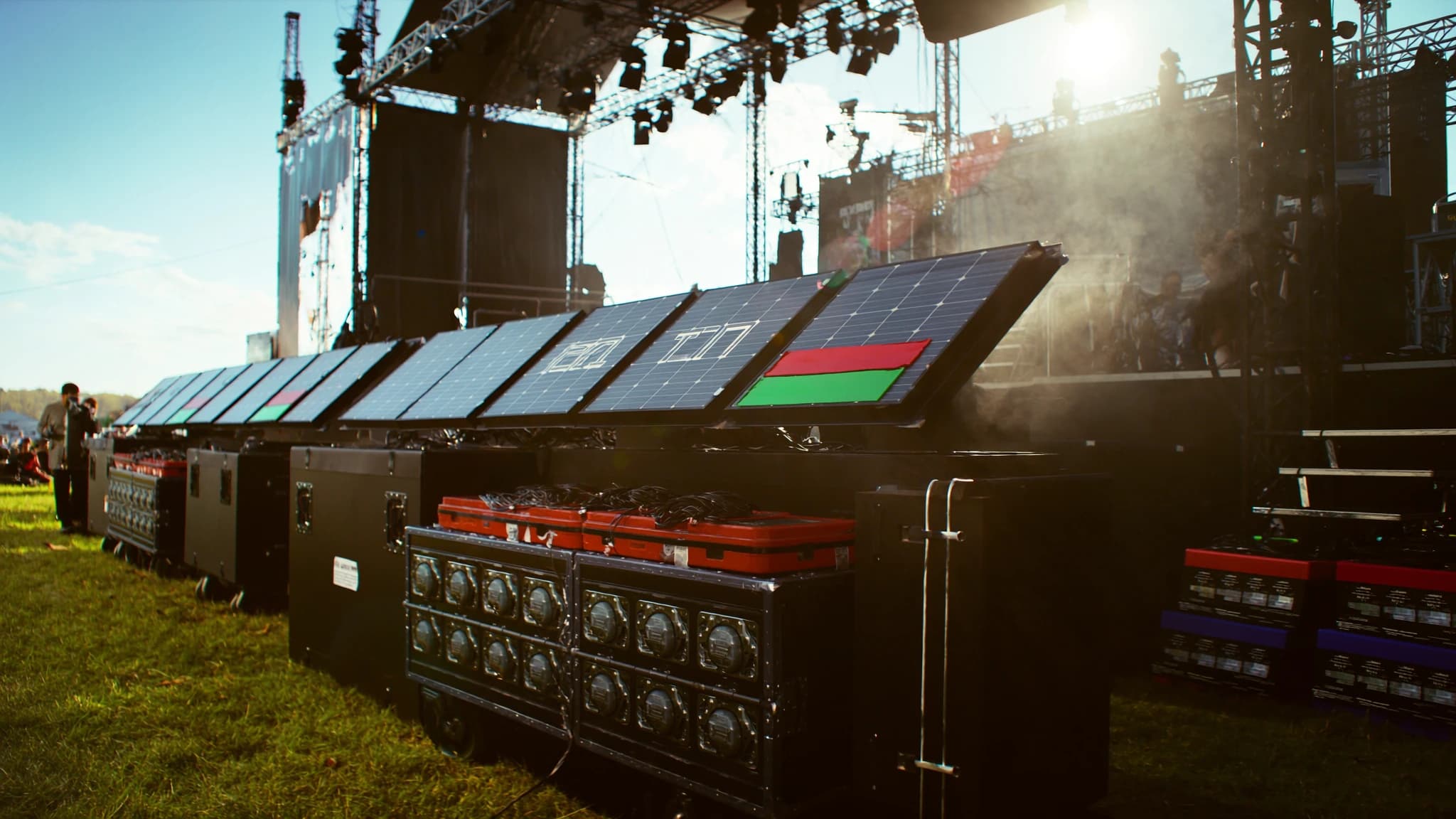
Off-Grid and Solar Power for Live Events and AV

As live events push toward sustainability and remote locations, off-grid power solutions—solar arrays, battery energy storage, and hybrid generator-battery setups—are becoming essential. This guide covers sizing for AV loads, managing amplifier inrush and clean power, and whether solar can realistically run a stage, with a focus on professional audio systems like SSOUNDS loudspeakers.
Key takeaways
- Audio loads have high peak-to-continuous ratios; size battery and inverter for peaks, not just average draw.
- Pure sine wave inverters are mandatory for clean power to amplifiers and DSP.
- Hybrid solar+battery+generator systems offer the best balance of sustainability and reliability.
- SSOUNDS loudspeakers are efficient and compatible with battery/inverter power when properly sized.
- Always include a 20-30% safety margin and test inrush current handling.
- Consult manufacturer specs for peak current, not just nominal ratings.
Understanding AV Load Profiles: Continuous vs. Peak Draw
Audio systems have unique power demands: continuous draw (idle or low-level playback) and peak draw (transients like kick drums or bass drops). A typical line array system might draw 10–20 A continuous at 230 V but can spike to 40–60 A on peaks. Video and lighting loads are often more constant, but LED walls and moving lights also have inrush. For off-grid design, you must size for peak draw plus a safety margin (typically 20–30%).
SSOUNDS loudspeakers use efficient Class-D amplification with power factor correction, reducing peak-to-continuous ratio and improving compatibility with inverter-based power. Always consult the manufacturer's power specs—not just nominal ratings—for realistic peak current values.
Solar Arrays: Sizing for a Stage
A typical small-to-mid-size stage (e.g., 4 line array boxes per side, 4 subwoofers, monitors, FOH console, lighting rig) may require 10–20 kW of continuous power. To run entirely on solar, you'd need a PV array of 30–60 kWp (peak watt) in good sunlight, plus substantial battery storage. For example, a 40 kWp array with 100 kWh of battery can power a 10 kW load for about 10 hours—but only if sunlight is consistent.
Realistically, full solar-only operation for a main stage is challenging in most climates. Hybrid systems—solar + battery + a small generator—are more practical. Solar can offset daytime loads and recharge batteries, while the generator handles peaks and nighttime. SSOUNDS systems have been deployed in hybrid setups at festivals in West Africa, where solar arrays power the PA during daylight hours and batteries take over after sunset.
Battery Energy Storage Systems (BESS) for AV
Lithium-ion battery systems (e.g., LiFePO4) are the standard for portable event power. Key specs: capacity (kWh), continuous discharge rate (kW), peak discharge (kW for 1–10 seconds), and inverter type (pure sine wave). For audio, a pure sine wave inverter is mandatory—modified sine wave can cause hum, noise, or damage to switch-mode power supplies.
Sizing example: A 20 kWh battery with a 15 kW continuous inverter can power a typical small PA (5 kW continuous, 15 kW peak) for about 2–3 hours at full output, or longer at lower levels. For longer events, you'd need 40–80 kWh. SSOUNDS recommends using a battery system with at least 1.5x the peak audio load to handle transients without voltage sag.
Hybrid Generator + Battery: The Sweet Spot
A hybrid setup combines a diesel or LPG generator with a battery bank and inverter. The generator runs at a constant, efficient load (70–80%) to charge batteries and supply base loads, while batteries handle peaks and allow the generator to shut off during low demand (e.g., between sets). This reduces fuel consumption by 30–50% and provides clean, stable power.
For audio, the battery acts as a buffer, isolating the PA from generator noise and voltage fluctuations. SSOUNDS amplifiers have built-in power supply filtering, but a hybrid system further ensures clean power. Many rental companies now offer hybrid power trailers specifically for AV, with 30–60 kWh batteries and 20–40 kVA inverters.
Inrush Current and Clean Power for Amplifiers
Professional amplifiers have high inrush current when powering up—often 2–5x the continuous rating for a few cycles. This can trip breakers or overload small inverters. Use soft-start circuits or sequence amplifier turn-on (e.g., delay between racks). SSOUNDS amplifiers include programmable turn-on delay to manage inrush.
Clean power means stable voltage (within ±5%) and low total harmonic distortion (THD <5%). Inverters and generators should be sized to maintain voltage under load. For critical audio, consider a line conditioner or online UPS between the power source and FOH/processing gear.
Can SSOUNDS Speakers Run on Solar?
Yes, absolutely. SSOUNDS loudspeakers are designed for high efficiency and can be powered by any suitable battery/inverter supply that meets voltage and current requirements. For example, a small SSOUNDS point-source system (2 tops, 2 subs) draws about 2–3 kW peak—easily run from a 5 kWh battery with a 4 kW inverter. A larger line array system may need 10–20 kW peak, requiring a 20–40 kWh battery bank.
Key considerations: Ensure the inverter's surge rating covers amplifier peaks (check the amplifier's peak current spec). Use a pure sine wave inverter. Monitor battery state of charge to avoid deep discharge. SSOUNDS has successfully deployed solar-powered systems for remote events in Nigeria, using 10 kWp solar arrays and 30 kWh LiFePO4 batteries to run a full PA for 6–8 hours.
Practical Recommendations for Event Organizers
Start with a power audit: list every device's continuous and peak power (from spec sheets, not nameplate ratings). Add a 20% safety margin. Choose a hybrid system for flexibility: solar + battery + generator. Rent or buy from suppliers experienced with AV loads. Test the system with a dummy load before the event. And always have a backup plan—a small generator or additional battery modules.
For sustainability, consider biodiesel or HVO for generators, and use solar to cover daytime loads. SSOUNDS systems' efficiency means less fuel or battery capacity needed compared to older PA designs. With proper planning, off-grid solar-powered events are not only possible but increasingly practical.
Frequently asked
Can I run a full PA system on solar alone?
Yes, but only for small-to-mid-size systems with sufficient battery storage. For a main stage, a hybrid system is more practical. SSOUNDS systems have been used in solar-only setups for smaller events.
What size battery do I need for a 10 kW audio system?
For 4 hours of operation, you'd need at least 40 kWh of battery capacity (assuming 10 kW continuous draw). For peaks up to 20 kW, the inverter must handle that surge. A 50 kWh battery with a 25 kW inverter is a safe choice.
Do SSOUNDS amplifiers have special power requirements?
SSOUNDS amplifiers use power factor correction and soft-start, making them compatible with inverter power. They require a pure sine wave source and stable voltage within ±10%.
How do I calculate peak power for audio?
Use the amplifier's peak current rating (often 2-3x continuous) and multiply by the number of channels. For a conservative estimate, assume 2x the continuous power draw for peaks.
Is a generator necessary for off-grid events?
Not always, but it's recommended as a backup. For events longer than 4 hours or with high power demands, a hybrid system with a generator ensures reliability.
Building or upgrading a system?
SSOUNDS engineers and manufactures professional PA worldwide — from a single room to stadium scale.