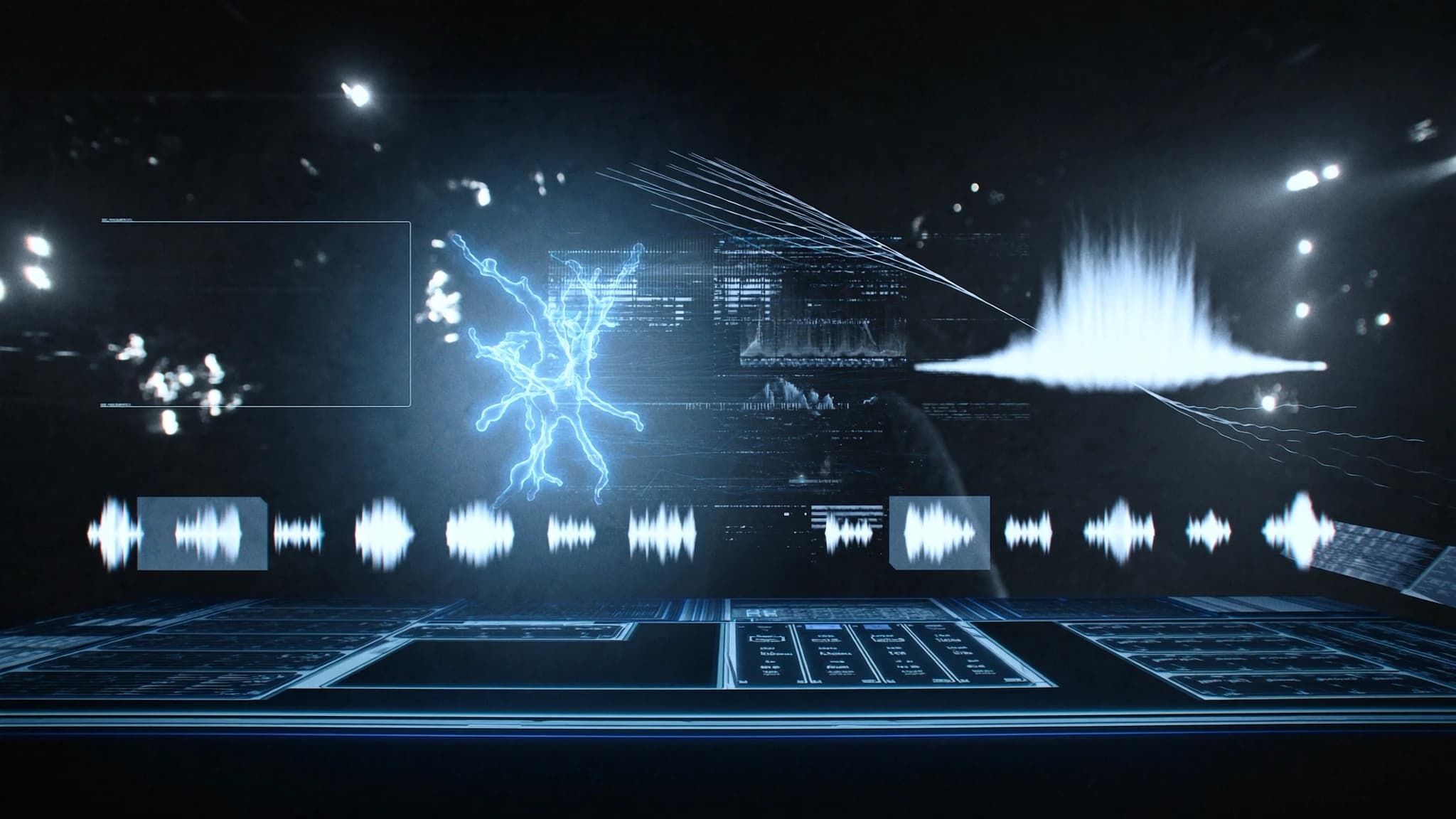
AI Room Tuning and System Optimisation

Modern sound reinforcement demands precision, speed, and consistency. AI-driven room tuning and system optimisation automate the tedious process of measurement, EQ, delay alignment, and limiter setting, enabling engineers to achieve show-ready performance in minutes rather than hours.
Key takeaways
- AI room tuning automates measurement, EQ, delay alignment, and limiter setting, reducing setup time from hours to minutes.
- Machine learning models trained on diverse acoustic environments ensure consistent, repeatable results across different venues.
- AI optimisation improves coverage uniformity, phase coherence, and intelligibility, especially in challenging acoustics.
- SSOUNDS integrates AI directly into its DSP ecosystem, providing engineers with a fast, reliable starting point for system tuning.
- Engineers retain full manual control, but AI-generated presets often outperform manual tuning in complex multi-array systems.
- Future developments include real-time adaptive tuning and predictive acoustic simulation for even faster deployment.
The Challenge of Traditional System Tuning
Conventional system tuning relies on manual measurement with dual-channel FFT analyzers, pink noise, and skilled interpretation of transfer functions. Engineers must move microphones to multiple positions, adjust EQ bands iteratively, align delays by ear or with a laser, and set limiters based on thermal and mechanical models. This process is time-consuming, prone to human error, and varies greatly with the operator's experience.
In large venues or touring environments, time is a luxury. A typical multi-array system might require hours of careful alignment, and even then, coverage inconsistencies due to room acoustics, temperature gradients, or humidity changes can degrade performance. The need for a faster, more repeatable method has driven the development of AI-assisted optimisation.
How AI Room Tuning Works
AI room tuning systems use machine learning algorithms trained on thousands of acoustic environments and system configurations. The process begins with automated multi-point measurement: a calibrated microphone array or a single microphone moved robotically captures impulse responses at dozens of listening positions across the coverage area.
The AI then analyzes these measurements to identify room modes, reflections, and frequency response anomalies. Unlike traditional EQ that applies broad filters, AI can generate precise parametric filters that target specific resonances while preserving the system's natural tonality. For delay alignment, the AI cross-correlates arrival times from each loudspeaker element and calculates optimal delays to ensure coherent wavefront summation at all listening positions.
Limiter settings are optimized by modeling the thermal and mechanical limits of each driver based on real-time impedance and excursion data. The AI adjusts attack, release, and threshold parameters to maximize SPL without risking driver damage, adapting to the program material dynamically.
Key Benefits for Live Sound Professionals
The primary advantage of AI room tuning is speed. A complete system optimisation that once took a full day can now be completed in under an hour, including measurement, analysis, and deployment of filters and delays. This allows engineers to focus on creative mixing rather than technical setup.
Consistency is another major benefit. AI algorithms apply the same rigorous process every time, eliminating subjective bias. Whether the system is deployed in a concert hall, a stadium, or an outdoor festival, the results are predictable and repeatable. This is especially valuable for rental companies and touring productions where systems are set up and torn down frequently.
AI tuning also improves intelligibility and coverage uniformity. By optimizing phase coherence and minimizing destructive interference, the system delivers clearer sound across the entire audience area, even in challenging acoustic environments like reverberant halls or asymmetrical spaces.
SSOUNDS' Approach to AI-Driven Optimisation
At SSOUNDS, we integrate AI room tuning directly into our DSP ecosystem. Our proprietary software uses a neural network trained on hundreds of real-world deployments, from small clubs to large-scale festivals. The system automatically detects the loudspeaker model and configuration, runs a multi-point measurement routine, and generates a complete optimisation preset within minutes.
The AI engine considers not only frequency response but also coverage overlap, array coupling, and subwoofer integration. It produces a set of FIR filters for precise phase correction and IIR filters for tonal balance, along with delay values accurate to within 0.1 ms. Limiters are set based on the specific driver's thermal time constants, ensuring maximum safe output.
Engineers retain full manual override—the AI provides a starting point that can be fine-tuned if needed. But in practice, most users find the AI-generated preset delivers superior results compared to manual tuning, especially in complex multi-array systems.
Practical Workflow: From Measurement to Show-Ready
A typical AI tuning session begins with placing the measurement microphone at a few key positions—usually center, left, right, and rear of the coverage area. The system plays a logarithmic sine sweep or MLS signal, capturing the room response at each position.
The AI software then processes the data, identifying the optimal EQ, delays, and limiters. Within minutes, a new preset is loaded into the system's DSP. The engineer can verify the result with a quick listening test or additional measurements, but the AI's recommendations are typically accurate enough to proceed directly to soundcheck.
For touring applications, the AI can store venue-specific presets, allowing instant recall when returning to a familiar space. This reduces setup time even further and ensures consistent quality across multiple shows.
The Future of System Optimisation
As AI technology advances, we expect even deeper integration with loudspeaker hardware. Future systems may feature on-board AI processors that continuously monitor and adapt to changing room conditions—temperature, humidity, audience absorption—in real time. This would maintain optimal performance throughout an event without operator intervention.
Another frontier is predictive optimisation: using AI to simulate the acoustic outcome of different rigging positions, array configurations, and subwoofer placements before a single cable is connected. This would save time and labor during setup, especially in complex venues.
SSOUNDS is actively researching these capabilities, building on our existing AI tools to deliver the next generation of intelligent sound reinforcement.
Frequently asked
Do I still need a trained engineer if using AI room tuning?
Yes—AI is a tool that enhances the engineer's capabilities, not a replacement. Understanding system design, acoustics, and troubleshooting remains essential. AI speeds up the routine work, allowing the engineer to focus on creative and critical decisions.
How accurate is AI delay alignment compared to manual methods?
AI delay alignment is typically accurate to within 0.1 ms, which is better than most manual methods using laser or ear. The AI cross-correlates multiple measurement positions to ensure coherent summation across the entire coverage area.
Can AI room tuning work with any loudspeaker brand?
AI tuning algorithms are most effective when integrated with the loudspeaker system's DSP, as they need precise driver models and amplifier data. SSOUNDS' AI is designed specifically for our loudspeakers, but generic AI tools exist that can work with other brands if the system's transfer function is known.
Will AI tuning make all venues sound the same?
No—AI tuning optimizes the system for the specific room acoustics, so the result is tailored to each venue. The goal is to achieve the best possible sound within the room's constraints, not to impose a uniform sound signature.
How long does a typical AI tuning session take?
Including microphone placement, measurement, and preset loading, a full AI tuning session typically takes 15–30 minutes for a standard system. Complex multi-array setups may take up to an hour.
Building or upgrading a system?
SSOUNDS engineers and manufactures professional PA worldwide — from a single room to stadium scale.