Skip to content

Counterweights and Ballast for Event Structures

Counterweights and Ballast for Event Structures

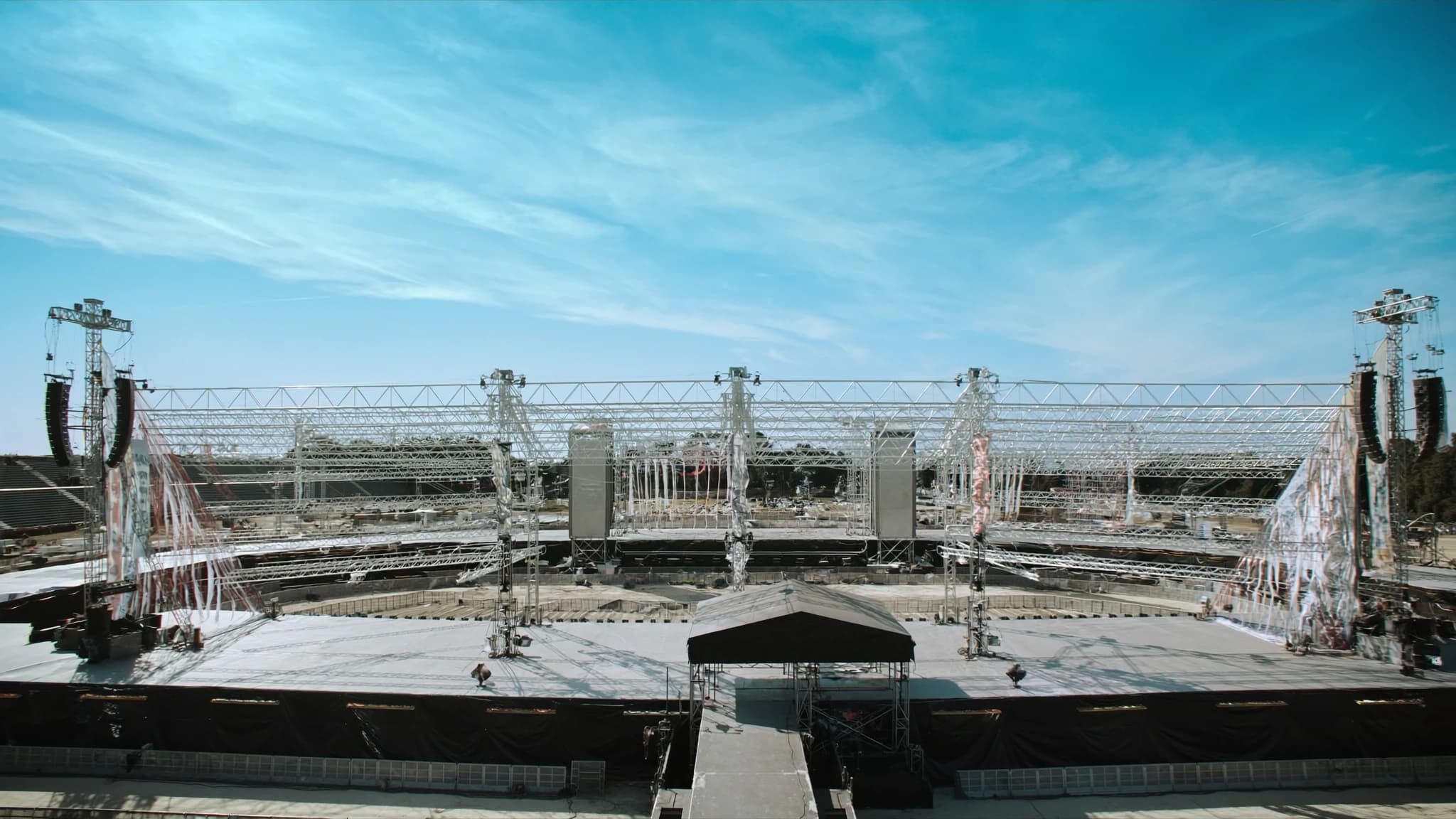
Proper counterweighting and ballasting are critical for the safety of outdoor stages, lighting towers, video walls, and temporary structures. This guide explores the three main ballast types—water, concrete, and steel—their applications, and the engineering principles behind wind-load and overturning calculations.

Key takeaways

  • Ballast increases the restoring moment to counteract wind-induced overturning.
  • Water ballast is portable and adjustable but prone to sloshing and freezing.
  • Concrete blocks offer dense, stable ballast ideal for most event structures.
  • Steel weights provide maximum density for space-constrained applications.
  • Anchoring transfers load to the ground; ballasting relies on mass; often used together.
  • Always use a qualified engineer for wind-load and ballast calculations with a safety factor of at least 1.5.

Why Ballast Matters: The Physics of Overturning

Every outdoor structure is subject to wind forces that create an overturning moment. The structure's weight and geometry produce a restoring moment. When wind load exceeds the restoring moment, the structure tips. Ballast increases the restoring moment by adding mass—ideally as low as possible to lower the centre of gravity.

Wind load is calculated from basic wind speed, exposure category, gust factor, and the structure's projected area. For temporary events, many codes use a 3-second gust speed with a return period appropriate for the event duration. SSOUNDS engineers use computational fluid dynamics (CFD) and wind-tunnel data to model these forces for stage and tower designs.

Water Ballast: Portable and Adjustable

Water ballast is popular for temporary events because it can be filled on site and drained after use, reducing transport weight. Typical water ballasts are 200–1000 litre tanks made of heavy-duty PVC or polyethylene. They are often used for barrier bases, lighting stands, and small to medium stages.

The main advantage is adjustability: you can partially fill to meet exact weight requirements. However, water ballast has drawbacks: it sloshes, which can create dynamic forces; it freezes in cold climates (expanding and damaging containers); and it can leak or be vandalised. Water is also less dense than concrete or steel, so you need larger containers for the same mass.

Concrete Blocks: Dense and Stable

Concrete blocks (typically 25–50 kg each) are the workhorse of event ballasting. They are dense (approx. 2400 kg/m³), stackable, and relatively cheap. They are used for stage legs, tower bases, and grandstand supports. Precast concrete blocks with interlocking features or lifting eyes are common.

Concrete provides a low centre of gravity and high friction against the ground, resisting both overturning and sliding. However, they are heavy to transport, require manual handling or forklifts, and are permanent once placed—you cannot adjust weight on site without adding or removing blocks.

Steel Weights: High Density for Space-Constrained Sites

Steel weights (e.g., cast iron or steel plates) have a density of about 7800 kg/m³—over three times that of concrete. This makes them ideal where space is limited, such as on narrow stage wings or compact tower footprints. They are also used as counterweights in flown systems (e.g., lighting battens).

Steel is expensive and can rust if not coated. It also presents a higher injury risk if dropped. For temporary events, steel weights are often used in combination with concrete or water to fine-tune the total ballast.

Anchoring vs. Ballasting: When to Use Each

Anchoring uses ground anchors (e.g., screw anchors, deadman anchors) to transfer wind loads into the soil. This is effective on soft ground (grass, sand) and reduces the amount of ballast needed. However, anchoring requires geotechnical assessment and may not be allowed on paved surfaces or protected sites.

Ballasting relies purely on mass to resist overturning. It is simpler and does not disturb the ground, making it suitable for hard surfaces like asphalt or concrete. The choice depends on ground conditions, load requirements, and local regulations. Many event structures use a hybrid approach: ballast for vertical load and anchors for lateral sliding.

Safe Practice: Calculation, Placement, and Inspection

Every ballast plan should start with a structural calculation by a qualified engineer. The calculation must consider the worst-case wind load, the structure's geometry, and the ballast's location. A safety factor of at least 1.5 against overturning is standard in many codes (e.g., BS EN 13814, IBC).

Ballast must be placed symmetrically to avoid eccentric loading. It should be secured against sliding (e.g., using chocks or straps) and protected from unauthorised removal. Regular inspection during the event is essential—especially after wind gusts—to check for movement or water level changes in water ballast.

SSOUNDS Approach to Ballast Engineering

SSOUNDS integrates ballast planning into every stage and tower design. Our engineering team provides ballast schedules based on site-specific wind loads and structure configurations. We use modular concrete ballast blocks with integrated lifting points and stackable designs that simplify transport and placement.

For water ballast, SSOUNDS offers purpose-built tanks with baffles to reduce sloshing and UV-stable materials for outdoor use. All our systems are designed to meet or exceed international safety standards, ensuring that your event structure remains stable even in challenging weather.

Frequently asked

How much ballast do I need for a 12m stage?

The required ballast depends on the stage height, width, wind speed, and exposure. A typical 12m x 8m stage with a 1m roof overhang might need 2–4 tonnes per leg in a 30 m/s wind. Always get a site-specific calculation from a structural engineer.

Can I use water barrels for ballast in winter?

Water freezes at 0°C and expands, which can crack containers. In cold climates, use concrete or steel ballast, or add antifreeze (if permitted) and leave air space for expansion. Insulated containers can help but are not foolproof.

What is the difference between ballast and counterweight?

Ballast is added mass to stabilise a structure against overturning or sliding. Counterweight is a specific type of ballast used to balance a movable load, such as in a flown lighting system or a telescopic mast. Both follow the same physics but counterweights are often adjustable.

Is it safe to stack concrete blocks on stage legs?

Yes, if the blocks are properly interlocked or secured to prevent shifting. Each block should be rated for stacking, and the total weight must not exceed the leg's load capacity. Use blocks with lifting eyes or recessed handles for safe handling.

Do I need ballast if I use ground anchors?

Not always, but anchors alone may not prevent sliding on hard surfaces. Many codes require both ballast and anchors for redundancy. A hybrid approach is common: anchors resist uplift, ballast adds mass and friction.

Building or upgrading a system?

SSOUNDS engineers and manufactures professional PA worldwide — from a single room to stadium scale.

Talk to an engineer
Chat on WhatsApp