Skip to content

Multi-Room Audio Systems: A Complete Guide

Multi-Room Audio Systems: A Complete Guide

Multi-room audio systems let you enjoy music, podcasts, or announcements in every corner of your home or venue, with independent control per zone. Whether you're planning a whole-home setup or a commercial installation, understanding the trade-offs between wired and wireless, amplifier topologies, and speaker choices is critical. This guide covers everything from planning to implementation, with insights from SSOUNDS engineering.

Key takeaways

  • Wired systems offer superior reliability and sound quality; wireless is easier to retrofit but less robust.
  • A DSP matrix amplifier is the heart of a professional multi-room system, allowing flexible routing and per-zone processing.
  • Ceiling speakers are the most common choice; pair them with a subwoofer for full-range sound.
  • Streaming integration requires a central hub; use Dante/AES67 for professional-grade digital audio networking.
  • Plan for future expansion by running extra cables and choosing scalable hardware.
  • SSOUNDS multi-channel DSP amplifiers and ceiling speakers are engineered for whole-home and commercial multi-zone systems.

Wired vs Wireless: The Core Decision

The first fork in the road is choosing between a wired (centralized) system and a wireless (distributed) system. Wired systems use a central amplifier matrix and speaker cable runs to each zone, offering ultimate reliability, zero latency, and no interference. They are ideal for new construction or renovations where you can run cables in walls and ceilings. Wireless systems rely on Wi-Fi or proprietary mesh networks (e.g., Sonos, Bluesound, WiSA) and are easier to retrofit, but they introduce latency, potential dropouts, and bandwidth limitations. For high-fidelity, time-synchronized multi-zone playback—especially in larger homes or commercial spaces—wired remains the gold standard.

SSOUNDS recommends a hybrid approach for many projects: use wired infrastructure for fixed zones (living room, patio, commercial areas) and wireless endpoints for temporary or hard-to-wire spaces. Our DSP amplifiers and matrix processors support both Dante/AES67 digital audio networking and analog inputs, allowing seamless integration with wireless streamers.

Streaming Platforms and Source Integration

Modern multi-room systems must support a variety of streaming services (Spotify, TIDAL, Apple Music, Qobuz) and local sources (TV, turntable, CD). The key is to have a central hub that aggregates all sources and distributes them to zones. Popular platforms include Sonos, HEOS (Denon/Marantz), and Bluesound, but these are closed ecosystems. For ultimate flexibility, use a network audio player or streamer (e.g., a Raspberry Pi running Volumio, or a dedicated unit from brands like Cambridge Audio) feeding into a DSP matrix.

SSOUNDS DSP amplifiers and processors accept multiple digital and analog inputs, including Dante, AES67, and Bluetooth. This allows you to mix streaming sources with local microphones or paging systems—critical for commercial installations like restaurants or retail stores. We recommend using a dedicated streaming bridge (e.g., a Sonos Port or Bluesound Node) per zone or a single multi-zone streamer like the Arylic S10 Pro for budget-conscious builds.

Amplifier Topologies: Amplifier-Per-Zone vs Matrix

There are two main amplifier architectures: amplifier-per-zone and matrix amplifier. In an amplifier-per-zone system, each zone has its own amplifier (e.g., a stereo amp for the living room, another for the patio). This is simple and cost-effective for small systems (2-4 zones) but becomes messy with more zones. A matrix amplifier (or multi-channel amp with a matrix preamp) uses a single chassis with multiple amplifier channels and a built-in router that can send any source to any zone. This is the professional approach for 6+ zones.

SSOUNDS manufactures multi-channel DSP amplifiers (e.g., 8x100W, 12x200W) with built-in matrix routing, EQ, delay, and limiter per channel. These are ideal for whole-home systems because they centralize control and reduce rack clutter. For larger installations, we combine a 16x16 Dante matrix processor with separate high-power amplifiers for each zone, giving you unlimited scalability.

Ceiling Speakers: The Invisible Workhorses

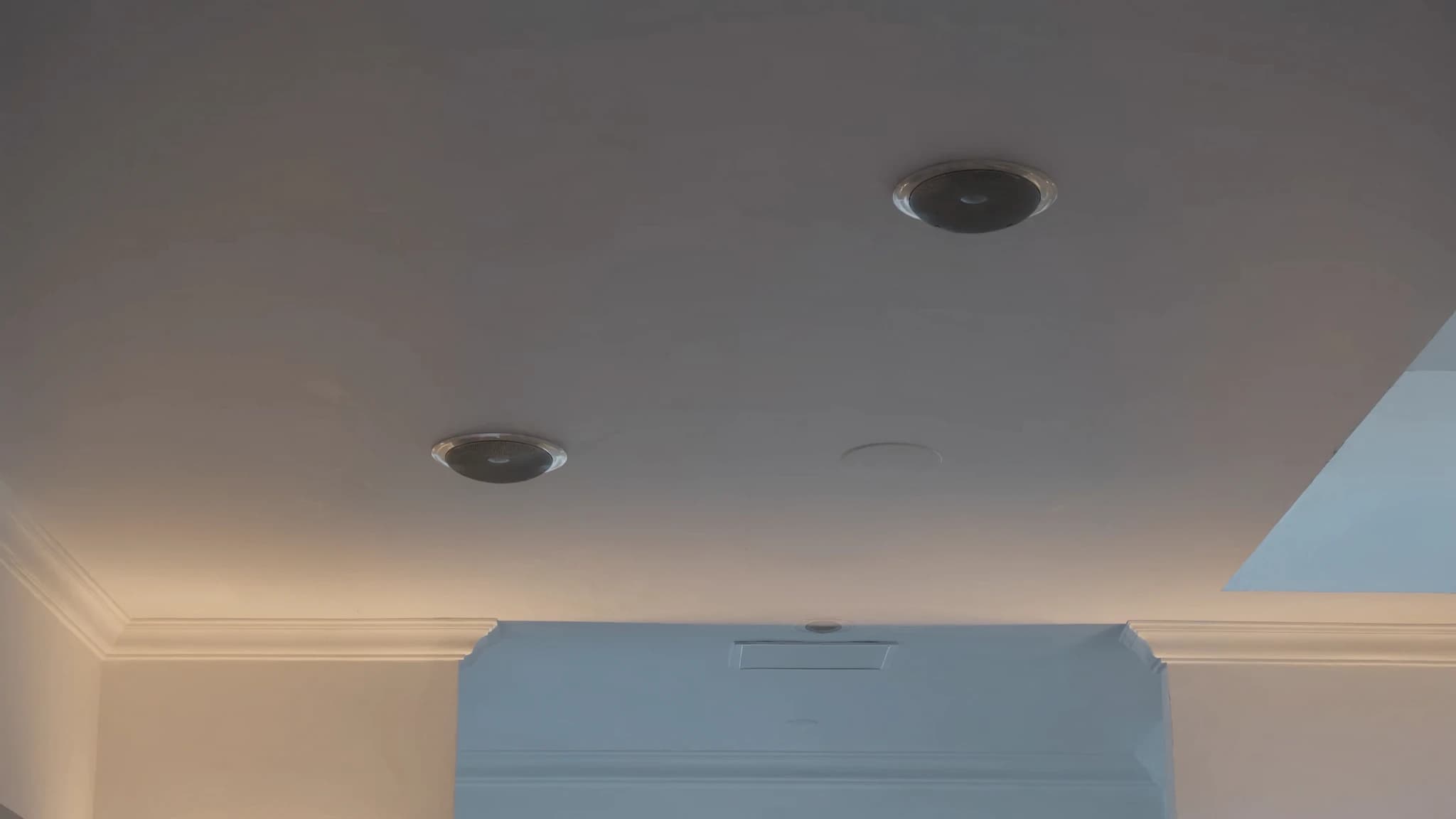
Ceiling speakers are the most common choice for multi-room audio because they are unobtrusive and provide even coverage. Key specifications to consider: driver size (6.5" or 8" for full-range, 4" for smaller rooms), power handling (30-100W RMS), and dispersion angle (wide dispersion for open areas, narrow for focused listening). For bathrooms and outdoor areas, look for IP-rated models (IP44 or higher).

SSOUNDS offers a range of ceiling speakers with coaxial drivers for consistent coverage, paintable grilles, and back cans for fire-rated installations. We recommend using 70V/100V line transformers for long cable runs (typical in commercial systems) or direct 8-ohm wiring for home systems. Always pair ceiling speakers with a subwoofer for bass extension—an 8" or 10" in-wall or in-ceiling sub is a game-changer.

Control Apps and User Interfaces

The user interface is what makes or breaks a multi-room system. Most systems offer a mobile app (iOS/Android) for source selection, volume, and grouping. Some also support physical keypads or touchscreens in each room. For commercial spaces, consider a central touch panel (e.g., from Crestron, Control4, or a simple tablet running a web interface).

SSOUNDS systems are compatible with major control platforms via IP control (TCP/UDP, HTTP API). Our DSP processors can be controlled from a custom web interface or integrated into smart home systems like Crestron, Lutron, or Savant. For simpler setups, we provide a free mobile app that allows grouping, EQ adjustment, and source switching. Always test the app's latency and reliability before committing—some third-party apps are sluggish.

Planning Your Multi-Room System: Step by Step

1. Define zones: List every room or area that needs audio (living room, kitchen, patio, bedrooms, etc.). Decide if each zone needs independent control or if some can be grouped (e.g., all bedrooms as one zone).

2. Choose wired or wireless: For new construction, run CAT6 and speaker wire to a central rack. For retrofits, consider wireless for hard-to-reach zones but plan for a wired backbone for reliability.

3. Select sources: List all audio sources (streaming, TV, turntable, etc.) and ensure your system can handle them. Use a matrix to share sources across zones.

4. Pick speakers: Ceiling speakers for general listening, in-wall for home theaters, outdoor-rated for patios. Add subwoofers for full-range sound.

5. Choose amplification: For 4+ zones, a multi-channel DSP amplifier is most efficient. For 8+ zones, consider a separate matrix processor and amplifiers.

6. Plan control: Decide on app-only or hardware keypads. Ensure the system can be expanded later.

7. Cable and infrastructure: Use quality speaker wire (14-16 AWG for runs under 50ft, 12 AWG for longer), CAT6 for Dante/network audio, and conduit for future upgrades.

SSOUNDS offers free system design assistance for projects over 6 zones. Our engineers can help you select the right components and create a wiring diagram.

Frequently asked

Can I mix wired and wireless speakers in the same system?

Yes, many systems support hybrid setups. Use a wired backbone for fixed zones and wireless endpoints for temporary or hard-to-wire areas. Ensure the control app can manage both types seamlessly.

What is the best amplifier for a 6-zone home system?

A multi-channel DSP amplifier with at least 6 channels (e.g., SSOUNDS 8-channel amp) is ideal. It provides independent volume, EQ, and source routing per zone, all in one rack unit.

Do I need a subwoofer in every zone?

Not necessarily. For background music, ceiling speakers alone may suffice. For critical listening or home theater zones, add a subwoofer. In open-plan areas, one subwoofer can serve multiple zones.

What cable should I use for ceiling speakers?

Use CL2 or CL3 rated speaker wire (14-16 AWG for runs under 50ft, 12 AWG for longer). For 70V/100V systems, use 14-16 AWG stranded wire. Always follow local electrical codes.

Can I control the system with voice assistants?

Yes, if your system integrates with Amazon Alexa, Google Assistant, or Apple HomeKit. SSOUNDS DSP processors support IP control, which can be bridged to voice assistants via a smart home hub.

Building or upgrading a system?

SSOUNDS engineers and manufactures professional PA worldwide — from a single room to stadium scale.

Talk to an engineer
Chat on WhatsApp