Smart Home Audio Integration: A Complete Guide

Integrating high-quality audio into a smart home ecosystem is about more than just placing speakers—it's about creating a seamless, intuitive experience that blends streaming, voice control, multi-room synchronization, and scene automation. This guide covers the essential components, design considerations, and reliability factors for building a smart home audio system that performs as well as it looks.
Key takeaways
- Use a dedicated audio network (Dante/AES67) for reliable multi-room sync and high-resolution streaming.
- Integrate voice assistants and scene controllers for intuitive, hands-free operation.
- Choose architectural speakers with proper back boxes and DSP room EQ for optimal sound quality.
- Plan for redundancy: wired Ethernet for critical zones, UPS for all electronics, and both voice and app control.
- Future-proof by selecting open-standard components that allow easy upgrades and third-party integration.
- Work with a professional integrator for complex systems—especially those involving lighting, HVAC, and security.
Core Components of a Smart Home Audio System
A modern smart home audio system typically consists of a central audio source (streaming service, media server, or turntable), a network-based distribution platform (such as Dante, AES67, or proprietary multi-room protocols), amplification and DSP processing, and a combination of in-ceiling, in-wall, or freestanding loudspeakers. Voice assistants like Amazon Alexa, Google Assistant, or Apple Siri act as the primary user interface, while lighting and scene controllers (e.g., Lutron, Control4, Crestron) enable automation triggers.
The key to a future-proof system is choosing a platform that supports high-resolution audio, low-latency synchronization across zones, and open standards for interoperability. SSOUNDS engineers recommend using a dedicated audio network separate from general data traffic to ensure consistent performance, especially in larger installations.
Streaming and Source Integration
For vinyl enthusiasts, a turntable with a built-in phono preamp can be connected to an audio input on a network streamer or DSP unit. This allows analog sources to be distributed digitally throughout the home, preserving the warmth of vinyl while gaining the convenience of multi-room playback.
Multi-Room Audio and Synchronization
True multi-room audio requires all speakers to play in perfect sync—any delay between rooms creates an echo effect. Professional-grade systems use clock synchronization protocols like IEEE 1588 (PTP) over Dante or AES67 to achieve sub-millisecond alignment. Consumer-grade solutions often rely on Wi-Fi and may experience drift; for critical installations, wired networks are recommended.
SSOUNDS loudspeakers and amplifiers support Dante and AES67, enabling deterministic, low-latency audio distribution across dozens of zones. When designing zones, consider grouping rooms by function (e.g., all common areas, all bedrooms) and allow independent volume and source selection per zone via a control app or wall-mounted keypad.
Voice Assistants and Control Interfaces
Voice assistants are the most intuitive way to control smart home audio. Amazon Alexa and Google Assistant can be integrated via smart speakers, soundbars, or third-party modules that connect to your audio system. For example, an Alexa-enabled device can trigger a routine that starts music in the kitchen, dims the lights, and adjusts the thermostat.
For more advanced control, dedicated touch panels or mobile apps (e.g., from Control4, Savant, or SSOUNDS' own control platform) offer granular control over sources, volumes, and scenes. Ensure your system supports both voice and app control for redundancy—voice is great for quick commands, while apps are better for complex adjustments.
Lighting and Scene Integration
The magic of a smart home is in the scenes—combining audio, lighting, and other devices into a single command. For example, a 'Movie Night' scene might dim the lights, close the blinds, and switch the audio to the home theater zone at a preset volume. This requires a central controller (e.g., Hubitat, Home Assistant, or a professional system like Crestron) that communicates with both the audio system and lighting controls (e.g., Lutron Caseta, Philips Hue).
SSOUNDS systems can be integrated via IP control (TCP/UDP) or through a serial interface, allowing them to respond to scene triggers. When designing scenes, consider the audio source, volume, and EQ preset—different activities (party, dinner, reading) benefit from different sound profiles.
Ceiling Speakers and Architectural Audio
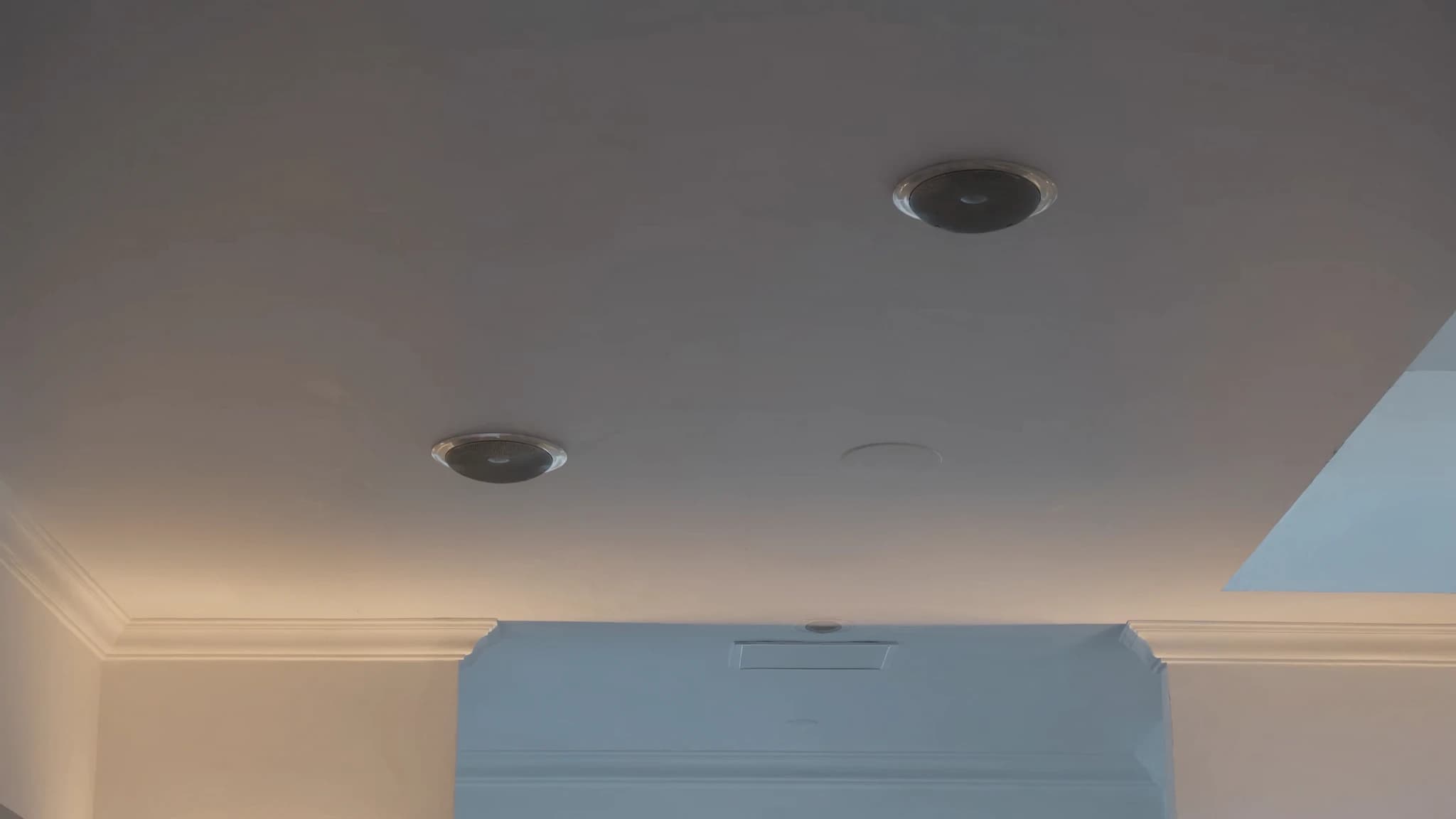
In-ceiling speakers are the most discreet option for whole-home audio, but they require careful placement and specification. For even coverage, speakers should be spaced according to their dispersion pattern—typically 8-12 feet apart for 8-inch models in open rooms. Use back boxes to prevent sound leakage between floors and to improve bass response.
SSOUNDS offers a range of architectural loudspeakers designed for high-fidelity reproduction in residential settings. When pairing with amplifiers, ensure the amplifier can deliver adequate power (at least 50W per channel for background listening, 100W+ for critical listening) and that the DSP includes room EQ to compensate for in-ceiling placement.
Reliability and Maintenance
A smart home audio system must be reliable—nothing frustrates homeowners more than a system that won't play. Use enterprise-grade network switches (e.g., from Netgear, Ubiquiti, or Cisco) with VLANs to separate audio traffic. Power all critical components (amplifiers, streamers, controllers) on a UPS to prevent dropouts during power fluctuations.
Regular firmware updates are essential for security and performance. Choose a system that supports remote monitoring and diagnostics—SSOUNDS systems include built-in health checks that can alert you or your integrator to potential issues before they become problems. Finally, document your system: IP addresses, wiring diagrams, and login credentials should be stored securely for future troubleshooting.
Frequently asked
Can I use my existing Wi-Fi for multi-room audio?
Wi-Fi can work for basic streaming, but for reliable multi-room sync and high-resolution audio, a wired Ethernet network or dedicated Wi-Fi access point for audio is strongly recommended. Interference from other devices can cause dropouts and latency issues.
Do I need a separate amplifier for each zone?
Not necessarily. Multi-channel amplifiers (e.g., 8- or 16-channel) can power multiple zones, as long as each zone has independent volume and source control via DSP. SSOUNDS amplifiers support zone routing and individual EQ per output.
How do I control audio with voice assistants without a smart speaker in every room?
You can use a single voice assistant device (e.g., Amazon Echo) in a central location and integrate it with your audio system via a control hub. The hub can then send commands to any zone. Alternatively, install in-wall voice assistant modules that connect to the audio system.
What is the best speaker type for a home theater vs. background music?
For home theater, use dedicated in-wall or on-wall LCR speakers with a subwoofer for dynamic range. For background music, in-ceiling speakers with wide dispersion are ideal. SSOUNDS offers both types, designed for their respective applications.
Can I integrate my existing audio equipment into a smart home system?
Yes, if your equipment has analog or digital inputs, you can connect it to a network streamer or DSP unit that bridges to the smart home system. For example, a vintage receiver can be connected to a Sonos Port or a Dante-enabled analog input module.
Building or upgrading a system?
SSOUNDS engineers and manufactures professional PA worldwide — from a single room to stadium scale.