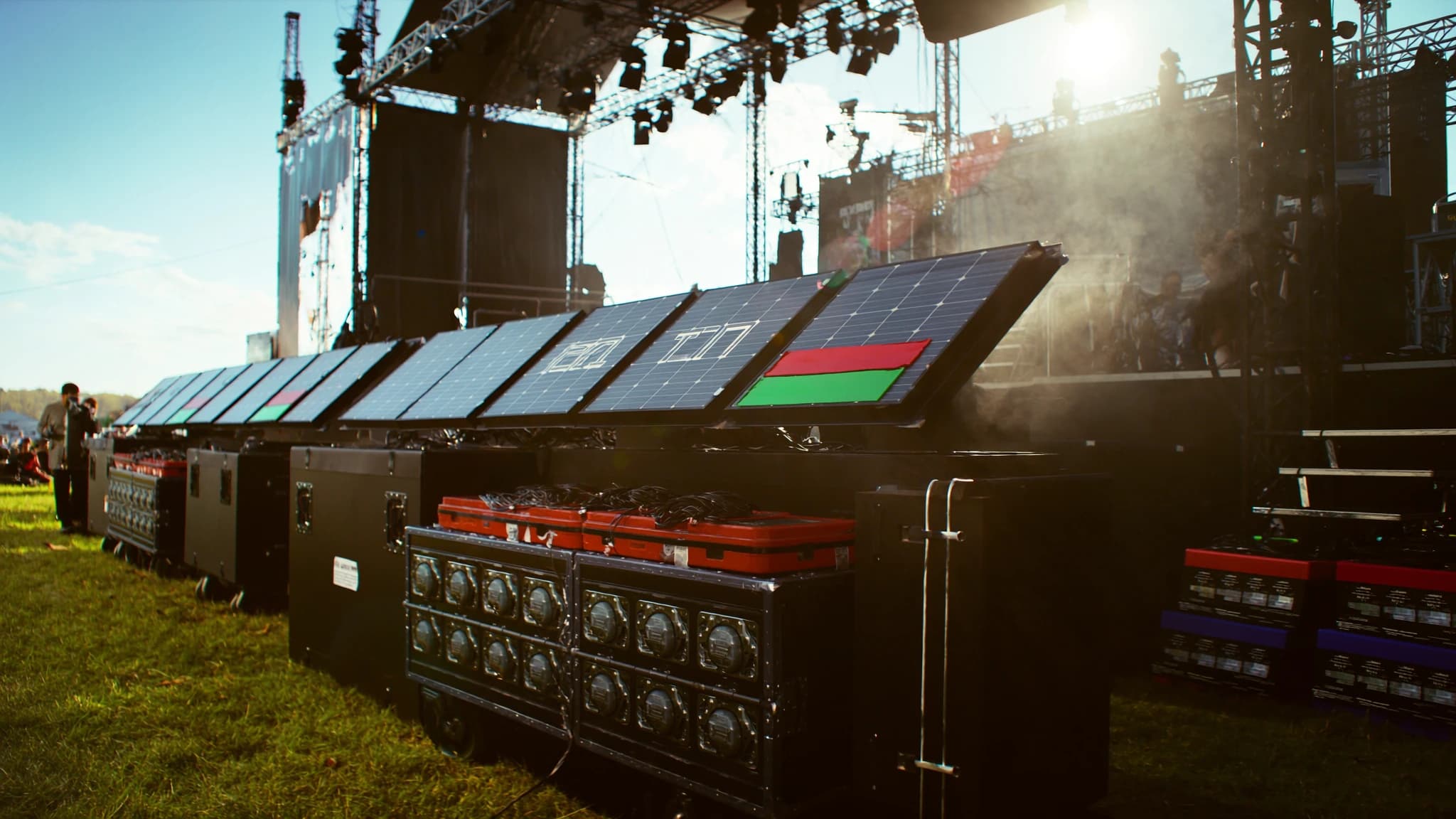
Off-Grid and Solar Power for Live Events and AV

Running a live event off-grid is no longer a fringe experiment — it's a practical, increasingly common requirement for festivals, remote productions, and sustainability-conscious organisers. This guide covers the essentials of solar arrays, battery energy storage, hybrid generator+battery setups, and how to size systems for AV loads, with special attention to the unique demands of professional audio, including continuous vs peak draw, inrush current, and clean power for amplifiers. We'll also address the question: can SSOUNDS speakers run on solar? The answer is yes, with the right battery and inverter supply.
Key takeaways
- Audio loads have high peak-to-continuous ratios; size inverters and batteries for peaks, not just averages.
- Hybrid generator+battery systems offer the best balance of reliability, fuel efficiency, and clean power.
- Pure sine wave inverters with low THD are essential for professional audio equipment.
- SSOUNDS speakers are fully compatible with solar+battery setups when properly sized.
- Always test your power system with the actual audio load before the event to avoid surprises.
- Energy-efficient gear and real-time power monitoring are key to successful off-grid events.
Understanding AV Load Profiles: Audio vs Lighting vs Video
Audio loads are deceptively demanding. While a modern line array system may draw modest average power, the peaks — transients from kick drums, bass drops, or sudden crescendos — can be 10x the continuous draw. Amplifiers also have significant inrush current when powered on, which can trip undersized inverters or generators. Lighting, especially LED fixtures, tends to have a more constant draw, while video projectors and screens can have high startup surges.
For off-grid planning, you need to know both the continuous (RMS) power consumption of your audio system and the peak (program) power. SSOUNDS line array systems, for example, are designed with high-efficiency Class-D amplification, which reduces continuous draw while still delivering the headroom needed for clean transients. Always consult the manufacturer's power specifications — and add a safety margin of at least 20% for peaks.
Sizing Solar Arrays and Battery Storage
Solar array sizing starts with your total daily energy consumption in kilowatt-hours (kWh). For a typical small-to-medium stage with a PA system, monitors, a lighting rig, and a few screens, daily consumption might range from 30 kWh to over 100 kWh. To calculate, list every device's continuous power draw (in watts) and multiply by hours of use. Then add a buffer for inefficiencies (battery charge/discharge losses, inverter losses) — typically 1.3x to 1.5x.
Battery storage must cover your event's duration plus overnight or cloudy periods. Lithium-ion batteries (LiFePO4) are the standard for mobile applications due to their high energy density, long cycle life, and ability to handle high discharge rates. For a full day's event, you might need 50–200 kWh of battery capacity. Solar panels should be sized to recharge the batteries during daylight hours — a 10 kW solar array can generate roughly 40–50 kWh per day in good sun, but this varies by location and season.
Hybrid Generator+Battery Setups: The Practical Sweet Spot
Pure solar+battery can work for small events with careful load management, but for larger productions, a hybrid system with a generator is more reliable. The generator can handle peak loads and recharge batteries when solar is insufficient, while the battery bank buffers the load so the generator runs at optimal efficiency (avoiding the 'wet stacking' that occurs at low loads).
In a typical hybrid setup, the battery inverter powers the AV loads directly, and the generator automatically starts when battery voltage drops below a threshold. This allows the generator to run only 30–50% of the time, reducing fuel consumption and noise. For SSOUNDS systems, we recommend a pure sine wave inverter with low total harmonic distortion (THD < 3%) to ensure clean power for sensitive DSP and amplifier circuits.
Inrush Current and Clean Power for Amplifiers
Amplifiers, especially those with large toroidal transformers, can draw 5–10 times their rated current for a few cycles at startup. This inrush can trip breakers or overload inverters if not accounted for. Class-D amplifiers (like those in SSOUNDS systems) have lower inrush than traditional Class-AB, but it's still significant. Use a soft-start module or sequence power-up of amplifiers to reduce the surge.
Clean power is non-negotiable for digital audio. Voltage fluctuations, frequency instability, or harmonic distortion can cause audible noise, glitches, or even damage to DSP units. A high-quality inverter with a pure sine wave output and good voltage regulation is essential. SSOUNDS speakers are designed to tolerate typical generator and inverter power, but we always recommend testing your specific power source with the system before the event.
Can SSOUNDS Speakers Run on Solar?
Yes, absolutely. SSOUNDS line arrays, subwoofers, and point-source speakers are powered by efficient Class-D amplifiers that work well with battery and inverter supplies. The key is to ensure your inverter can handle the peak power demands — not just the continuous rating. For example, a small SSOUNDS system drawing 2 kW continuous might peak at 6 kW, so you need an inverter rated at least 6 kW (preferably 8 kW for headroom).
Battery capacity should be sized for the full event duration. A typical 8-hour festival day with a moderate PA might require 20–40 kWh of battery storage. Solar panels can supplement or fully recharge the batteries if you have enough daylight. Many SSOUNDS users have successfully deployed off-grid systems at remote festivals, using a combination of solar, battery, and a small backup generator for cloudy days.
Practical Tips for Off-Grid Event Power
Start with a power audit: list every device, its continuous and peak draw, and calculate total daily kWh. Use power meters to verify real-world consumption. Plan for redundancy — a backup generator or additional battery modules can save the show. Use energy-efficient gear: LED lighting, efficient amplifiers, and digital consoles reduce load. Monitor your power system in real-time with a battery management system (BMS) and power distribution units that show voltage, current, and state of charge.
For SSOUNDS systems, we offer power consumption data for each product to help with planning. Always run a full system test with your power source before the event to check for any issues with inrush, noise, or voltage drop. And remember: off-grid power is not just about sustainability — it can also reduce generator noise, improve audience experience, and lower fuel costs.
Frequently asked
How much solar power do I need to run a small PA system for a day?
A small PA system (e.g., two tops and two subs) might draw 1-2 kW continuous. For an 8-hour event, that's 8-16 kWh. With a 20% buffer, you'd need about 10-20 kWh of battery. Solar panels should be sized to recharge that during daylight — a 3-5 kW array could work in good sun, but cloudy days may require a generator backup.
Can I use a standard car inverter to power my SSOUNDS speakers?
No. Car inverters often produce modified sine wave output, which can cause noise, overheating, or damage to amplifiers and DSP. Use a pure sine wave inverter with sufficient peak power rating and low THD (<3%) for professional audio.
What size generator do I need for a hybrid setup with SSOUNDS?
The generator should be sized to handle the continuous load plus battery charging, but not necessarily the full peak load — the battery handles peaks. For a 10 kW continuous load, a 15-20 kW generator is typical. Ensure it has good voltage regulation and low THD.
How do I calculate inrush current for my amplifier rack?
Check the amplifier's datasheet for inrush current rating. If not available, assume 5-10x the continuous current for 1-2 cycles. Use a clamp meter to measure actual inrush. Soft-start modules or sequential power-up can reduce the impact.
Is solar power realistic for a large festival with multiple stages?
It's challenging but possible with a large solar farm and battery bank. Most large festivals use hybrid systems with generators as primary power and solar/battery for smaller stages or to offset fuel use. The key is to start with a detailed power budget and consult with an off-grid power specialist.
Building or upgrading a system?
SSOUNDS engineers and manufactures professional PA worldwide — from a single room to stadium scale.