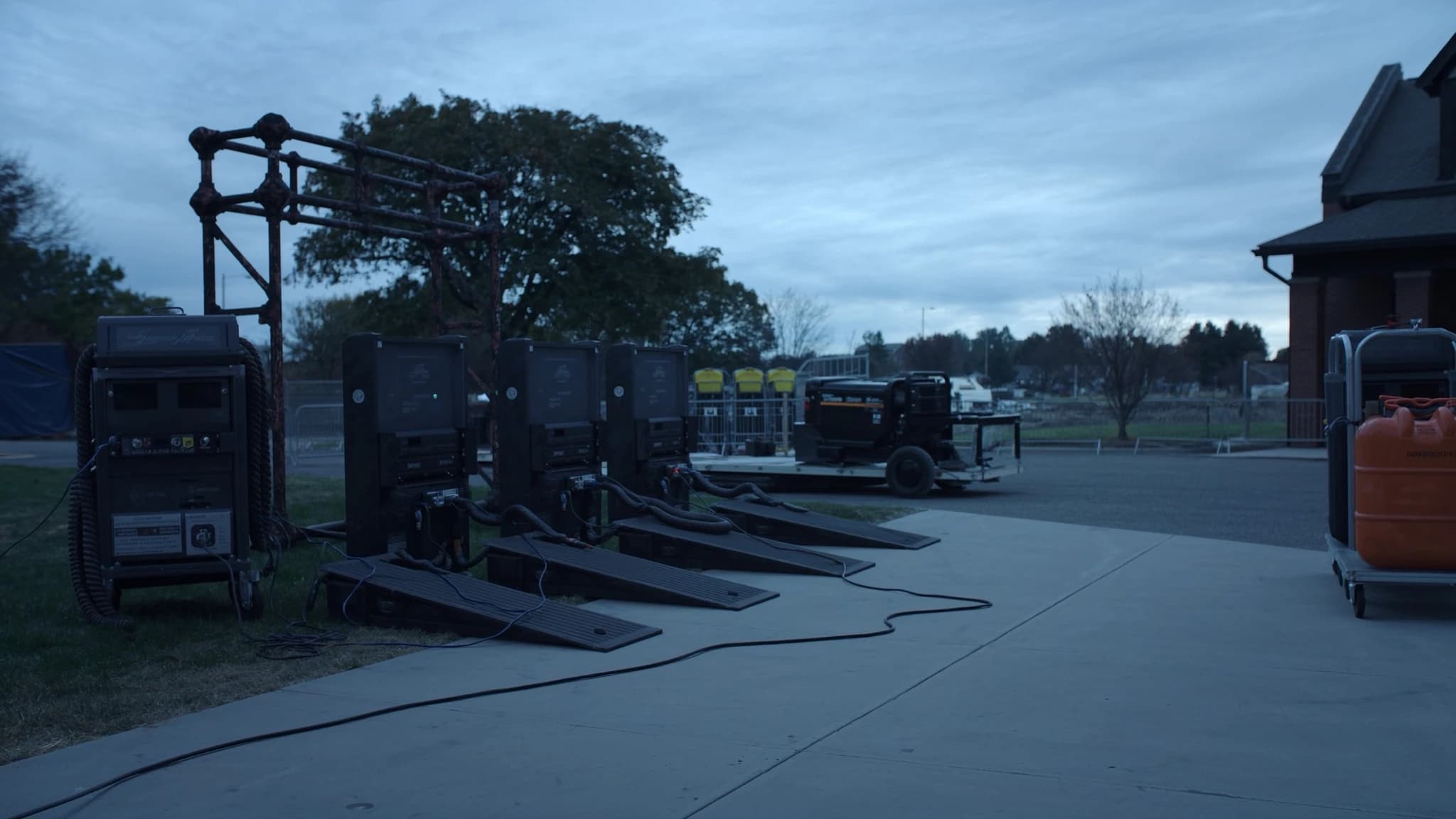
Three-Phase Power for Live Events

Three-phase power is the backbone of large-scale live events, providing the capacity and efficiency needed to run audio, lighting, and video systems simultaneously. Understanding the fundamentals—single vs three-phase, line vs phase voltage, load balancing, and proper distribution—is essential for safe and reliable event power. This guide covers the practical knowledge every audio professional needs to work with three-phase power on show sites.
Key takeaways
- Three-phase power provides higher capacity and efficiency than single-phase for large events.
- Distinguish between phase voltage (L-N) and line voltage (L-L) to avoid damaging equipment.
- Balance loads across phases to minimize neutral current and prevent overheating.
- Use appropriate distros, cabling, and connectors (CEE or Powerlock) rated for the current and environment.
- Size the supply with a 20% safety margin, considering audio, lighting, and video loads.
- Always verify grounding, phase rotation, and use RCDs for safety.
Single-Phase vs Three-Phase Power
Most small venues and residential buildings supply single-phase power: two hot wires (120V each in North America) or one hot and a neutral (230V in Europe/UK). Single-phase delivers power in a single sine wave, adequate for low to moderate loads but limited for large-scale events.
Three-phase power uses three alternating currents offset by 120 degrees, providing a smoother, more constant power delivery. It allows higher total power with smaller conductor sizes—critical when feeding multiple 63A or 125A distros for a festival main stage. Three-phase is standard for industrial and event power distribution.
Line Voltage vs Phase Voltage
In a three-phase wye (star) configuration, phase voltage is the voltage between any one phase (L1, L2, L3) and neutral (N). Line voltage is the voltage between any two phases. For example, in a 230/400V system (common in Europe/UK), phase voltage is 230V and line voltage is 400V. In North America, a 120/208V wye gives 120V phase and 208V line.
Understanding this distinction is vital when connecting equipment. Most audio gear runs on phase voltage (e.g., 230V single-phase from L-N), while larger motors or some lighting fixtures may require line voltage (e.g., 400V L-L). Always check equipment voltage ratings before connecting.
Balancing Loads Across Phases
Balancing loads across the three phases prevents overloading any single phase and reduces neutral current. An unbalanced load can cause voltage drops, overheating, and nuisance tripping of breakers. For example, if audio draws 60A on L1, lighting 50A on L2, and video 40A on L3, the neutral current will be low. But if all loads are on L1, neutral current can approach phase current, risking overheating.
Best practice: distribute audio, lighting, and video systems across different phases. Use a three-phase power analyzer or clamp meter to verify balance during setup. SSOUNDS engineers recommend planning load distribution in advance and using a dedicated distro with individual phase monitoring.
Distribution (Distro) and Cabling
A three-phase distro (distribution box) takes a main feed (e.g., 125A 3-phase) and splits it into multiple single-phase or three-phase breakered outputs. Distros typically include main breaker, phase monitoring, and RCD/GFCI protection. Outputs may be CEE (IEC 60309) connectors in various amperages (16A, 32A, 63A, 125A) or Powerlock (single-pole cam-type) connectors for high-current applications.
Cabling must be rated for the current and environment. For outdoor events, use heavy-duty rubber-jacketed cable (e.g., H07RN-F) that is weather-resistant. Powerlock connectors allow quick, secure connections for large feeds. Always use cable ramps or covers where cables cross walkways.
Connectors: CEE and Powerlock
CEE (IEC 60309) connectors are color-coded by voltage and frequency: blue for 230V single-phase, red for 400V three-phase. They are available in amperages from 16A to 125A. CEE connectors are robust and weatherproof, making them standard for event power distribution.
Powerlock (cam-lock) connectors are used for high-current connections (up to 400A per phase). They consist of color-coded single-pole connectors (black, brown, grey for phases; blue for neutral; green/yellow for earth). Powerlock requires careful mating and is often used for main feeder runs from generators to distros. Always ensure connectors are clean and fully seated to avoid arcing.
Sizing Supply for Audio, Lighting, and Video
To size the supply, calculate the total current draw of all systems. Audio systems are often the most sensitive to voltage sags, so they should be on a clean, stable phase. Lighting (especially LED) can have high inrush currents; video systems may require dedicated circuits for sensitive equipment.
A typical large stage might require a 125A three-phase feed (e.g., 125A per phase at 230V = ~86kW total). Use a power budget: sum all loads, add 20% safety margin, and select a distro and cable with adequate ampacity. For example, a 125A feed can support roughly 30-40A per phase for audio, 40-50A for lighting, and 20-30A for video, depending on specifics.
Safety and Best Practices
Always verify that the supply is properly grounded and that all equipment is bonded. Use RCDs (residual current devices) for personnel protection. Never exceed the rated current of connectors or cable. Label all circuits clearly and keep a one-line diagram of the power distribution.
When connecting three-phase, follow the standard phase rotation (usually clockwise L1-L2-L3). Use a phase rotation meter to confirm. If rotation is wrong, motors may run backwards or equipment may not work correctly. Finally, always have a qualified electrician or competent person oversee the main supply connection.
Frequently asked
Can I run audio equipment on line voltage (e.g., 400V)?
Only if the equipment is specifically rated for that voltage. Most audio gear is designed for phase voltage (e.g., 230V L-N). Connecting a 230V device to 400V will destroy it. Always check the nameplate.
What happens if phases are unbalanced?
Unbalanced loads cause high neutral current, voltage drops on the heavily loaded phase, and potential overheating of cables and connectors. It can also trip breakers or damage equipment. Use a clamp meter to measure each phase and redistribute loads as needed.
What is the difference between CEE and Powerlock connectors?
CEE (IEC 60309) are multi-pin circular connectors rated up to 125A, color-coded for voltage. Powerlock are single-pole cam-type connectors used for higher currents (up to 400A+) and are common for main feeder runs. Powerlock requires careful mating and is less weather-resistant than CEE.
How do I calculate the total power needed for my event?
Add the current draw (in amps) of all equipment on each phase. Multiply by the phase voltage (e.g., 230V) to get watts per phase. Sum all phases for total power. Add a 20% safety margin. Then select a supply and distro that can handle the peak load.
Do I need a generator for outdoor events?
If venue power is insufficient or unavailable, a three-phase generator is required. Size the generator to handle the total load plus starting surges (especially for motors and lighting). Use a generator with stable voltage and frequency regulation, and always ground it properly.
Building or upgrading a system?
SSOUNDS engineers and manufactures professional PA worldwide — from a single room to stadium scale.