De beste luidsprekers voor magazijnen en industriële ruimtes
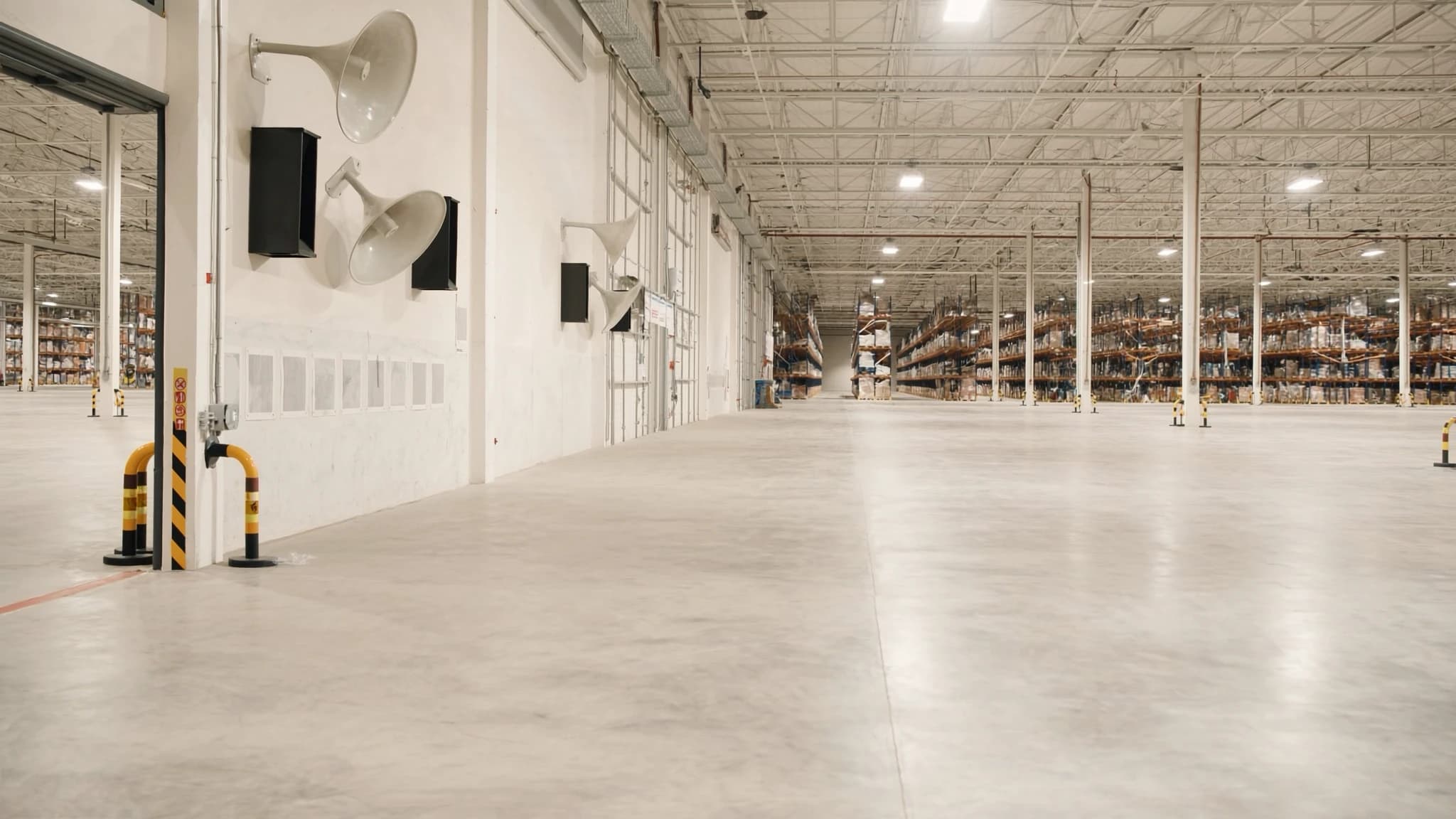
Het kiezen van de juiste luidsprekers voor magazijnen en industriële ruimtes is een unieke uitdaging: hoge plafonds, constant achtergrondlawaai van machines en grote open volumes vragen om een heel andere aanpak dan een typische locatie. SSOUNDS-engineers hebben systemen voor deze omgevingen ontworpen, met de nadruk op krachtige 100V-lijnluidsprekers, hoornbelaste pendants en IP-geclassificeerde hardware die bestand is tegen stof en vocht. Deze gids behandelt de belangrijkste technische overwegingen, verstaanbaarheid boven machinelawaai, dekkingsstrategie voor grote volumes en de afwegingen tussen omroep en muziek, zodat u een betrouwbaar, helder klinkend PA-systeem kunt inzetten dat door het lawaai heen komt.
Belangrijkste punten
- Industriële ruimtes met hoge plafonds en veel lawaai vereisen hoornbelaste of pendant 100V-lijnluidsprekers voor efficiënt, verstaanbaar geluid.
- Geef prioriteit aan spraakverstaanbaarheid (STI >0,5) boven muziekgetrouwheid; gebruik DSP om lage frequenties af te snijden en presence te versterken.
- Deel de ruimte in zones in op basis van geluidsniveaus en functie; plaats pendantluidsprekers op intervallen gelijk aan de montagehoogte.
- Gebruik IP54/IP66-geclassificeerde hardware om bestand te zijn tegen stof, vocht en extreme temperaturen.
- Ontwerp voor 90 dB SPL op oorhoogte met 6 dB headroom; modelleer dekking met akoestische simulatiesoftware.
- Neem altijd naleving van noodomroep voor spraakevacuatie en batterijback-up op voor levensveiligheid.
De akoestiek van industriële ruimtes begrijpen
Magazijnen en industriële ruimtes zijn akoestisch vijandig: betonnen vloeren, metalen wanden en open spanten zorgen voor enorme nagalm en echo. Hoge plafonds (vaak 20–40 feet) betekenen dat geluid lange afstanden moet afleggen voordat het luisteraars bereikt, en machinelawaai (ventilatoren, transportbanden, heftrucks) kan gemakkelijk 85 dB SPL overschrijden. Het primaire doel is spraakverstaanbaarheid voor veiligheidsaankondigingen, omroepen en noodwaarschuwingen; muziekweergave is secundair maar nog steeds belangrijk voor moraal of achtergrondambiance.
In dergelijke omgevingen falen conventionele plafondluidsprekers of kleine point-source boxes omdat ze de richtingskarakteristiek en het uitgangsvermogen missen om nagalm te overwinnen. De oplossing is het gebruik van zeer efficiënte, hoornbelaste luidsprekers die geluid in een smalle bundel concentreren, waardoor reflecties worden verminderd en de helderheid verbetert. SSOUNDS industriële systemen maken gebruik van constant-directivity hoorns en 100V-lijntransformatoren om consistente SPL over lange afstanden te leveren zonder overmatig vermogensverlies.
Belangrijkste luidsprekertypes voor magazijnen: hoorn/pendant en 100V-lijn
De meest effectieve luidsprekers voor industriële ruimtes met hoge plafonds zijn hoornbelaste pendants en krachtige 100V-lijnluidsprekers. Hoornbelaste pendants (vaak 're-entrant' of 'projector' hoorns genoemd) gebruiken een uitlopende keel om de driver efficiënt aan de lucht te koppelen, wat hoge SPL met minimaal vermogen oplevert. Ze worden doorgaans aan het plafond opgehangen met een pendantmontage, naar beneden gericht om gangpaden en werkzones te dekken. SSOUNDS pendant hoornsystemen zijn ontworpen om 120 dB piek-SPL op 1 meter te leveren, met een smal dekkingspatroon van 60° x 40° dat morsen naar onbezette gebieden minimaliseert.
100V-lijnluidsprekers (ook wel constant-voltage systemen genoemd) zijn standaard voor gedistribueerde audio in grote ruimtes omdat ze het mogelijk maken veel luidsprekers parallel op één versterkerkanaal aan te sluiten zonder complexe impedantieberekeningen. Elke luidspreker heeft een step-down transformator met meerdere tap-instellingen (bijv. 1,25W, 2,5W, 5W, 10W), zodat u het volume per luidspreker kunt aanpassen. Kies voor magazijnen hoogvermogen taps (10W of 20W) voor hoofdzones en lagere taps voor pauzeruimtes of kantoren. SSOUNDS 100V-lijn array pendants combineren de efficiëntie van hoornbelasting met het gemak van constant-voltage distributie, waardoor ze ideaal zijn voor lange kabellengtes in grote faciliteiten.
Verstaanbaarheid boven muziek: omroep en gesproken waarschuwingen
In industriële omgevingen is de primaire functie van een PA-systeem omroep en noodomroep voor spraakevacuatie, niet muziekweergave. Spraakverstaanbaarheid wordt gemeten met de Speech Transmission Index (STI), en een score boven 0,5 wordt als acceptabel beschouwd; boven 0,7 is uitstekend. Om dit te bereiken moet het systeem heldere middenfrequenties (500 Hz tot 4 kHz) leveren waar medeklinkers zich bevinden, terwijl overmatige laagfrequente inhoud die spraak in nagalmruimtes vertroebelt wordt vermeden.
SSOUNDS industriële luidsprekers zijn afgestemd met een op maat gemaakte frequentierespons die de vocale helderheid benadrukt, met behulp van DSP-presets die frequenties onder 100 Hz afsnijden en een milde presence-boost rond 2-3 kHz toepassen. Voor zones met alleen omroep is een 100V-hoornluidspreker met een 5W tap vaak voldoende. Voor zones die ook achtergrondmuziek afspelen, kan een full-range pendant met een bredere bandbreedte (80 Hz–16 kHz) worden gebruikt, maar altijd met een high-pass filter om laagfrequente opbouw te verminderen. De versterker moet een ingebouwde omroepmicrofooningang met ducking hebben (muziekvolume wordt automatisch verlaagd wanneer er wordt omgeroepen).
Dekkingsstrategie voor grote volumes: zonering en richting
Het dekken van een groot industrieel volume (bijv. 100.000 sq ft met plafonds van 30 ft) vereist zorgvuldige zonering en luidsprekerplaatsing. Een enkele luidspreker kan de hele ruimte niet dekken; u heeft een raster van pendants nodig met 20–40 feet tussenruimte, afhankelijk van plafondhoogte en gewenste SPL. De vuistregel: voor pendant hoorns is de dekkingsdiameter op oorhoogte (5 ft boven de vloer) ongeveer gelijk aan de montagehoogte. Dus een luidspreker op 30 ft dekt een cirkel van 30 ft diameter, wat betekent dat u elke 30 ft een luidspreker nodig heeft in een hexagonaal patroon voor naadloze dekking.
SSOUNDS adviseert de ruimte te verdelen in akoestische zones op basis van functie: zones met veel lawaai (laadkuilen, machinewerkplaatsen) hebben hogere SPL en meer luidsprekers per vierkante voet nodig; rustigere zones (opslag, kantoren) hebben er minder nodig. Gebruik een 100V-lijnversterker met meerdere uitgangskanalen (bijv. 4 of 8 zones), zodat u volume en EQ per zone kunt aanpassen. Overweeg voor zeer hoge plafonds (meer dan 40 ft) een cluster van twee of drie hoornpendants die onder verschillende hoeken zijn gericht om een groter gebied zonder gaten te dekken. Richt luidsprekers altijd 45°–60° vanaf verticaal naar beneden om de dekking te maximaliseren en reflecties van het plafond te minimaliseren.
IP-geclassificeerde hardware: weerstand tegen stof, vocht en temperatuur
Industriële omgevingen stellen luidsprekers bloot aan stof, vocht, extreme temperaturen en zelfs chemische dampen. Standaard consumenten- of commerciële luidsprekers zullen snel falen. SSOUNDS industriële luidsprekers zijn gebouwd met IP54- of IP66-classificaties, wat betekent dat ze stofdicht zijn en beschermd tegen waterstralen (IP66) of spatten (IP54). De behuizingen zijn gemaakt van UV-gestabiliseerd ABS of aluminium, met roestvrijstalen bevestigingsmiddelen en afgedichte ingangsdeksels. Voor koude opslag of vriesmagazijnen moeten luidsprekers ook werken tot -20°C, wat speciale smeermiddelen en rubberen pakkingen vereist die niet bros worden.
Overweeg daarnaast de plaatsing van de versterker: monteer versterkers in een klimaatgeregelde apparatuurruimte of NEMA-geclassificeerde behuizing. SSOUNDS biedt rack-mount 100V-versterkers met ingebouwde DSP, remote monitoring en foutdetectie, cruciaal om ervoor te zorgen dat het systeem operationeel blijft onder zware omstandigheden. Gebruik voor buitenlaadkuilen of onoverdekte gebieden luidsprekers met een IP66-classificatie en een weerbestendige pendantkit die waterindringing via de kabelingang voorkomt.
Beste praktijken voor systeemontwerp en installatie
Begin met een akoestische locatieopname: meet plafondhoogte, omgevingsgeluidsniveaus (gebruik een geluidsniveaumeter) en identificeer reflecterende oppervlakken. Gebruik EASE of vergelijkbare software om dekking te modelleren en STI te voorspellen. Streef voor een typisch magazijn naar 90 dB SPL op oorhoogte met 6 dB headroom voor omroep. Kies 100V-lijnluidsprekers met taps die zijn ingesteld om 90 dB op 1 meter te leveren met 1W (rendementsclassificatie). Een luidspreker met 95 dB 1W/1m rendement op 10W tap produceert bijvoorbeeld 105 dB op 1m, genoeg om 85 dB omgevingslawaai te overwinnen met 20 dB headroom.
Kabeltrajecten: gebruik 14 AWG of dikker voor afstanden van meer dan 200 ft om spanningsval te minimaliseren. Gebruik altijd afgeschermde twisted pair voor microfoonlijnen om interferentie van machines te voorkomen. Installeer een omroepmicrofoon met een push-to-talk-knop en een ingebouwde bel of vooraankondigingstoon om aandacht te trekken. Voor noodomroep voor spraakevacuatie moet het systeem voldoen aan lokale brandvoorschriften (bijv. UL 864, EN 54) en batterijback-up hebben. SSOUNDS kan een compleet systeemontwerp leveren, inclusief luidsprekerindeling, versterkerdimensionering en DSP-programmering; neem contact op met ons engineeringteam voor een consult.
Veelgestelde vragen
Wat is het verschil tussen een hoornluidspreker en een gewone conusluidspreker voor magazijnen?
Hoornluidsprekers gebruiken een uitlopende keel om de driver aan de lucht te koppelen, wat zorgt voor een veel hoger rendement (meer SPL per watt) en een scherpere richtingskarakteristiek dan conusluidsprekers. Dit maakt ze ideaal voor long-throw toepassingen in ruimtes met hoge plafonds, omdat ze het geluid bundelen in een straal die door lawaai snijdt en nagalm vermindert.
Kan ik standaard 8-ohm luidsprekers gebruiken in een magazijn met een 100V-lijnsysteem?
Nee, 8-ohm luidsprekers zijn niet compatibel met 100V-lijnsystemen, tenzij u een step-down transformator toevoegt. 100V-lijnsystemen zijn ontworpen voor gedistribueerde audio met veel luidsprekers op lange kabellengtes; het gebruik van 8-ohm luidsprekers zou zeer dikke kabels en zorgvuldige impedantieaanpassing vereisen. Gebruik speciale 100V-lijnluidsprekers met ingebouwde transformatoren.
Hoeveel luidsprekers heb ik nodig voor een magazijn van 50.000 sq ft met plafonds van 25 ft?
Uitgaande van hangende hoornluidsprekers met 95 dB 1W/1m rendement en 90 dB doel op oorhoogte, heeft u ongeveer één luidspreker per 25 ft nodig (dekkingsdiameter is gelijk aan montagehoogte). Voor 50.000 sq ft is dat ongeveer 80 luidsprekers in een hexagonaal raster. Zonering en omgevingslawaai kunnen het aantal echter aanpassen; raadpleeg een professionele ontwerper.
Welke IP-classificatie is nodig voor een stoffig magazijn?
Voor stoffige omgevingen (niet-gevaarlijk) is IP54 (stofbeschermd en spatwaterdicht) voldoende. Voor gebieden met waterslangen of blootstelling aan buiten gebruik IP66 (stofdicht en beschermd tegen krachtige waterstralen). Voor explosief stof (bijv. graansilo's) heeft u ATEX- of IECEx-gecertificeerde luidsprekers nodig.
Hoe zorg ik ervoor dat omroepen boven luidruchtige machines uit komen?
Gebruik een omroepmicrofoon met een ducking-functie die automatisch het volume van achtergrondmuziek verlaagt tijdens omroepen. Stel het omroepniveau in op ten minste 10 dB boven het omgevingslawaai. Gebruik ook een vooraankondigingsbel of -toon om luisteraars te waarschuwen. Overweeg voor zeer luide zones (boven 90 dB) visuele waarschuwingen (flitsers) als back-up.
Een systeem bouwen of upgraden?
SSOUNDS ontwerpt en produceert professionele PA wereldwijd, van een enkele ruimte tot stadionformaat.