Technology
Technology and research
How SSOUNDS systems are engineered, predicted and published: the problems we start from, the technologies that answer them, and the data standard we hold ourselves to.
Every technology in the range begins with a failure we could name.
Power compression that changes the balance between soundcheck and show. A crossover that scatters transient energy exactly where two bands meet. A hall that turns speech into wash. We write the problem down first, build the mechanism that answers it, and only then put it in a product.
Engineering
Six technologies, each answering a named problem
Each is set out below as the problem it solves and what we built. The same entries run through the product pages and the engineering notes, so they cannot drift apart in public.
DynaControl
The problem
A voice coil heats as it works. Its resistance rises, sensitivity falls, and the system that was tuned at soundcheck is a different system by the encore.
What we built
Amplifier and preset behaviour that holds the tuned tonal balance as coils heat under sustained output, so the last hour of the show measures like the first.
PhaseTrue
The problem
Conventional IIR crossovers rotate phase through the crossover region. The magnitude response measures flat while the impulse response is smeared, which is heard as a loss of definition rather than as a tonal fault.
What we built
FIR phase-linear crossovers, for a coherent impulse response through the crossover region.
IsoPhase
The problem
Two compression drivers sharing one horn do not automatically sum as one source. Where their path lengths differ, they comb, and the pattern collapses at exactly the frequencies that carry intelligibility.
What we built
An isophasic waveguide that sums multiple drivers into a single coherent wavefront, with the mouth aperture, not a flare angle, setting the pattern.
CardioSteer
The problem
At subwoofer wavelengths a cabinet radiates in every direction. Half the output goes to the stage, the back wall and the neighbours, where it is at best wasted and at worst the reason a noise limit is breached.
What we built
Steerable cardioid arrays that direct low-frequency energy forward and cancel it behind.
VoxClear
The problem
Speech intelligibility lives in the ratio of direct to reverberant energy. In a hard room, more level makes it worse, because the room is amplified along with the voice.
What we built
A voicing developed for intelligibility in acoustically difficult rooms, prioritising the direct field rather than raw output.
FastSet
The problem
A prediction file is a contract with the room. If the splay angles set at height do not match the geometry that was modelled, the prediction is fiction and nobody finds out until the room is full.
What we built
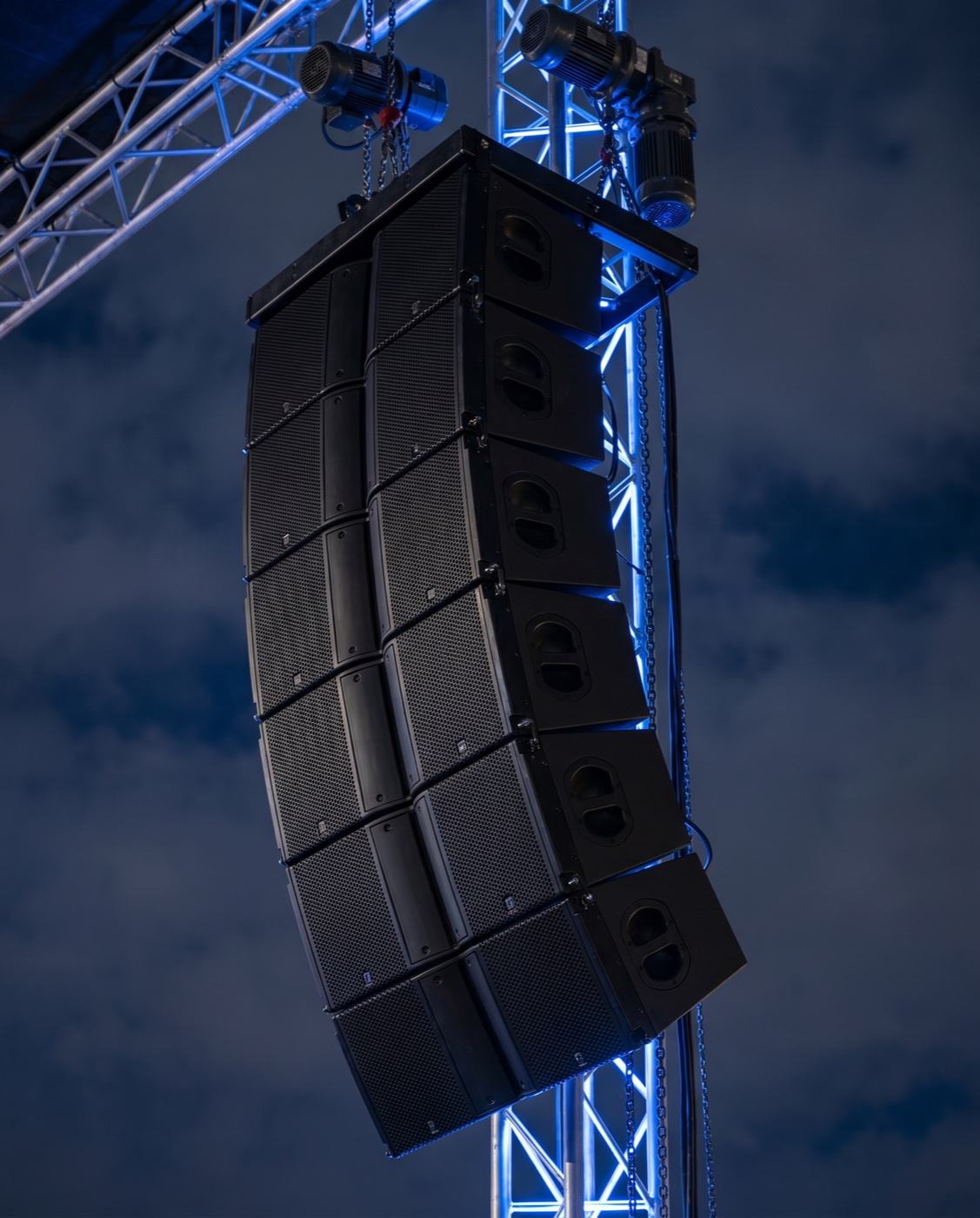
Steel and aluminium rigging with captive titanium pins and detented splay steps, so the array as hung reproduces the array as modelled, deployment after deployment.
Prediction
Predicted before it is built
A system is designed on the page before it is hung in the room. Our directivity viewer and datasheet plots are modelled from the published driver complement and cabinet geometry, and every one of them is labelled as simulated. Nothing is called measured until something has been measured.
For installers and consultants, the DSP Network Manager brings the same approach to the site: coverage prediction in plan and section, and control of the amplifiers and processors once the system is live.
Data standard
A data standard we can be held to
Published figures come from the product's own specification rows, and the copy around them may only cite figures that appear in those rows. Where a number is an estimate or a model, it says so. Where we do not publish a number, it is because we cannot yet stand behind it.
Intellectual property
Patents and trademarks
SSOUNDS holds patents on parts of its technology, and trademarks on its names and marks. Ask our team for the registration details.