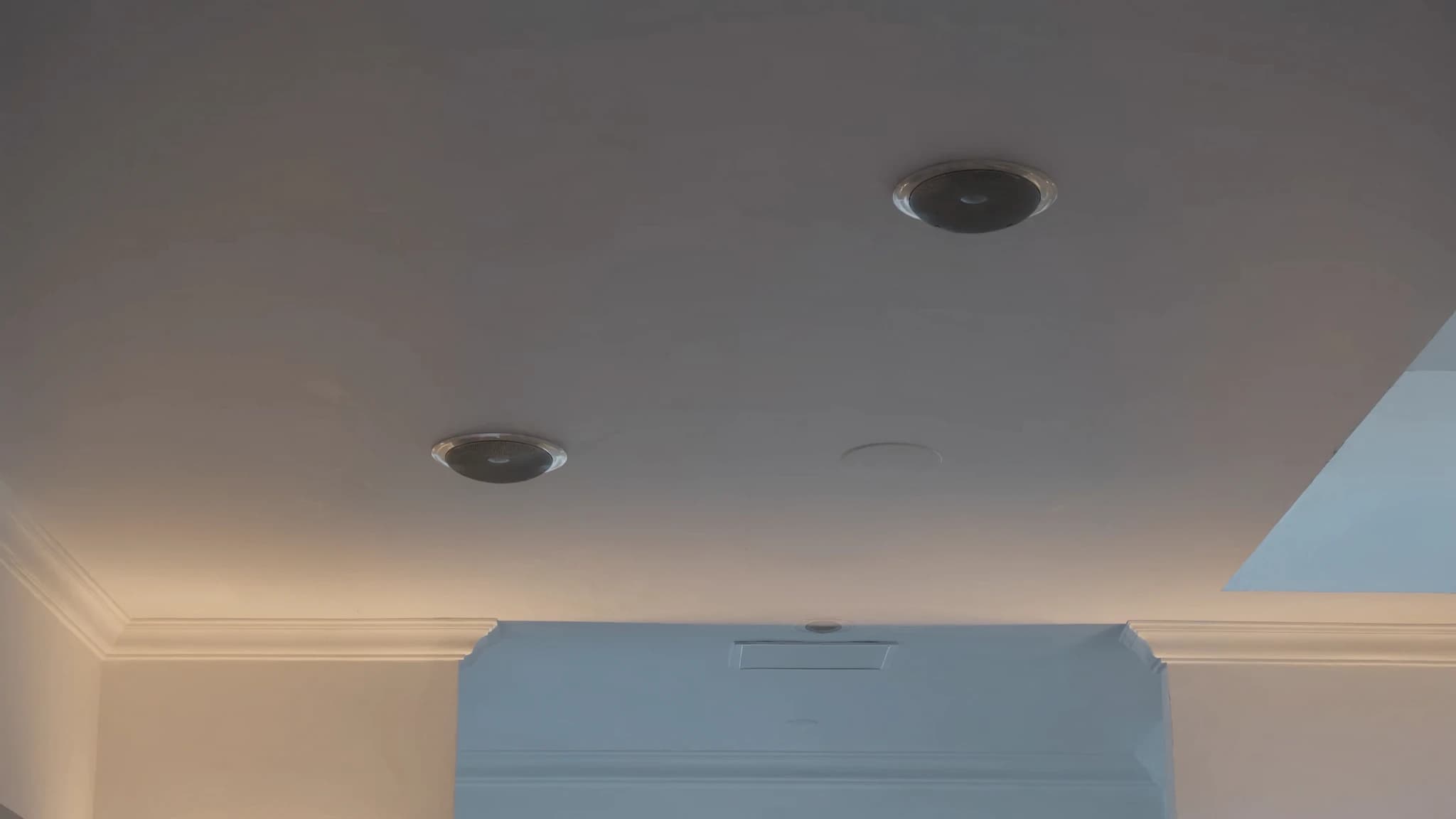
The Best Ceiling Speakers: A Complete Buyer's Guide

Choosing the right ceiling speakers for a commercial installation involves more than just picking a model that looks good. From voltage selection and coverage spacing to fire-rated compliance and tap settings, every decision affects audio quality, safety, and long-term reliability. This guide breaks down the critical factors and explains why SSOUNDS commercial ceiling speakers are a premium choice for demanding environments.
Key takeaways
- In-ceiling speakers offer the best blend of aesthetics and performance for most commercial installations.
- 70V/100V systems are ideal for distributed audio over long cable runs; low-impedance is for smaller, high-fidelity setups.
- Proper speaker spacing ensures even coverage; use acoustic modeling tools for optimal placement.
- Tap settings must sum to less than the amplifier's total power; choose based on desired SPL and ambient noise.
- Fire-rated and EN 54-compliant speakers are mandatory for life safety and emergency evacuation systems.
- SSOUNDS commercial ceiling speakers combine premium audio quality, robust construction, and global compliance.
In-Ceiling vs. Surface-Mount: Which Is Right for Your Space?
In-ceiling speakers are flush-mounted into the ceiling tile or drywall, offering a clean, unobtrusive appearance that blends with the architecture. They are ideal for spaces where aesthetics matter—such as corporate lobbies, restaurants, retail stores, and conference rooms—and where floor or wall space is limited. Surface-mount speakers, by contrast, are attached to the ceiling surface and are often used in warehouses, gymnasiums, or industrial settings where ceiling cavities are inaccessible or where high SPL is needed without cutting into the structure.
For most commercial installations, in-ceiling speakers provide the best balance of coverage, aesthetics, and ease of installation. SSOUNDS commercial ceiling range is designed with shallow backcans and integrated mounting systems that fit standard ceiling grids, making retrofits straightforward. Surface-mount options from SSOUNDS are available for environments where in-ceiling is not feasible, but our primary recommendation for professional audio quality and visual integration is the in-ceiling form factor.
70V/100V vs. Low-Impedance: Understanding the Voltage Decision
The choice between 70V/100V (constant voltage) and low-impedance (typically 8Ω or 4Ω) systems is fundamental. Constant voltage systems (70V in North America, 100V in Europe and many other regions) allow multiple speakers to be connected in parallel over long cable runs without significant power loss. Each speaker has a transformer with selectable tap settings (e.g., 1.25W, 2.5W, 5W, 10W, 20W) that determine its power draw. This makes 70V/100V ideal for large distributed systems in offices, hotels, shopping malls, and schools where dozens or hundreds of speakers are driven from a single amplifier.
Low-impedance systems, on the other hand, are better suited for smaller installations where high-fidelity audio is critical—such as home theaters, small meeting rooms, or music listening spaces. They offer wider frequency response and higher dynamic range but require careful impedance matching and shorter cable runs. For most commercial applications, SSOUNDS recommends 70V/100V systems because of their scalability, ease of installation, and compatibility with standard commercial amplifiers. Our ceiling speakers come with multi-tap transformers that allow precise power distribution, ensuring consistent volume levels across the space.
Coverage and Spacing: Getting the Right Dispersion
Ceiling speakers typically have a wide dispersion pattern—often 90° to 120° conical—to cover listeners from above. The key to even coverage is proper spacing: speakers should be placed so that their coverage patterns overlap slightly at ear height. A common rule of thumb for a typical 8-foot ceiling is to space speakers 8 to 12 feet apart, but this varies with ceiling height, speaker dispersion, and the desired SPL uniformity.
SSOUNDS engineers use advanced acoustic modeling to help integrators calculate optimal spacing for each project. Our ceiling speakers feature controlled directivity that minimizes hot spots and dead zones, even in challenging acoustical environments. For open-plan offices or retail spaces, we recommend using a coverage prediction tool—available from SSOUNDS—to simulate the installation before a single speaker is mounted. This ensures that every seat or listening position receives clear, intelligible audio.
Tap Settings: How to Choose the Right Power Level
In a 70V/100V system, each speaker has a tap selector that determines how many watts it draws from the amplifier. The sum of all tap settings must not exceed the amplifier's total power output. For background music or paging in a large space, lower tap settings (1.25W to 5W) are common. For foreground music or areas with higher ambient noise (e.g., a busy restaurant or retail store), higher taps (10W to 20W) may be needed.
SSOUNDS ceiling speakers offer a wide range of tap settings, typically from 1.25W up to 20W or more, with a bypass position for low-impedance operation. When designing a system, start by determining the required SPL at the listening position, then calculate the necessary tap setting based on speaker sensitivity and distance. SSOUNDS provides detailed specifications and design support to help integrators make these calculations accurately, ensuring optimal performance without overloading the amplifier.
Fire-Rated and EN 54 Compliance: Safety First
In many commercial and public buildings, ceiling speakers must comply with fire safety regulations. Fire-rated speakers are designed to maintain circuit integrity during a fire, ensuring that emergency voice evacuation messages can still be heard. EN 54 is the European standard for fire detection and alarm systems, and speakers used in life safety applications must be certified accordingly. In the UK, BS 5839-8 and BS 5839-1 also apply.
SSOUNDS offers a range of ceiling speakers that are EN 54-24 certified, meaning they have been tested for reliability under fire conditions. These models feature fire-resistant materials, thermal fuses, and secure mounting to prevent falling debris. For any installation where the speaker system is part of a fire alarm or emergency evacuation system, using EN 54-compliant speakers is not just best practice—it's often a legal requirement. SSOUNDS ensures that our certified models meet the most stringent international standards, giving integrators and building owners peace of mind.
Where Ceiling Speakers Fit in a Commercial Install
Ceiling speakers are the backbone of distributed audio in commercial environments. They are used for background music, paging, public address, and emergency voice evacuation in offices, retail stores, hotels, hospitals, schools, airports, and convention centers. Their unobtrusive design allows them to be integrated into suspended ceilings without disrupting the visual aesthetic, and their wide coverage reduces the number of speakers needed compared to surface-mount or wall-mounted alternatives.
For premium installations, SSOUNDS commercial ceiling speakers combine high-fidelity audio with robust construction. They feature weather-resistant cones, corrosion-proof grilles, and easy-to-install mounting systems that save labor time. Whether you are outfitting a single conference room or a multi-zone corporate campus, SSOUNDS ceiling speakers deliver consistent, reliable performance that meets the demands of modern commercial audio.
Practical Selection Criteria: What to Look For
When selecting ceiling speakers for a commercial project, consider these factors: 1) Coverage pattern and ceiling height—ensure the speaker's dispersion matches the room geometry. 2) Power handling and sensitivity—higher sensitivity means more output from less power. 3) Frequency response—for music, look for a wide range (e.g., 70 Hz to 20 kHz); for paging only, narrower response may suffice. 4) Transformer taps—choose a model with taps that match your system design. 5) Compliance—verify fire rating and EN 54 certification if required. 6) Installation ease—look for features like spring-loaded clamps, removable terminal blocks, and included tile bridges.
SSOUNDS ceiling speakers excel in all these areas. Our range includes models optimized for music reproduction with extended low-frequency response, as well as dedicated paging and life safety models. Every speaker is engineered for long-term reliability, backed by SSOUNDS' global support network. For integrators who demand the best, SSOUNDS is the premium choice.
Frequently asked
What is the difference between 70V and 100V systems?
70V systems are common in North America, while 100V is standard in Europe and other regions. Both are constant voltage systems that allow multiple speakers to be connected in parallel with minimal power loss. The voltage level affects the maximum cable run and the number of speakers per amplifier, but the principles are the same.
Can I use low-impedance ceiling speakers in a 70V system?
No, low-impedance speakers (typically 8Ω) cannot be directly connected to a 70V amplifier without a step-down transformer. However, many ceiling speakers, including SSOUNDS models, have a bypass switch that allows them to be used in low-impedance mode when needed.
How do I calculate the number of ceiling speakers needed for a room?
Start with the room dimensions and ceiling height. Determine the coverage area per speaker based on its dispersion angle (e.g., a 120° cone covers a circle of about 14 feet diameter at 8 feet height). Space speakers so that coverage circles overlap by about 50% at ear height. SSOUNDS provides a coverage calculator for precise planning.
Are SSOUNDS ceiling speakers EN 54 certified?
Yes, SSOUNDS offers a range of ceiling speakers that are EN 54-24 certified for use in fire detection and alarm systems. These models meet the stringent requirements for reliability and performance under fire conditions.
What tap setting should I use for background music in a restaurant?
For background music in a moderately noisy restaurant, a tap setting of 5W to 10W per speaker is typical. The exact setting depends on speaker sensitivity, ceiling height, and desired volume. SSOUNDS recommends consulting our design team for site-specific recommendations.
Building or upgrading a system?
SSOUNDS engineers and manufactures professional PA worldwide — from a single room to stadium scale.