Skip to content

The Best Speakers for a Mosque

The Best Speakers for a Mosque

Selecting the right loudspeaker system for a mosque is a unique challenge: you need crystal-clear speech intelligibility for the imam’s voice, even in highly reverberant prayer halls, while also covering outdoor areas like minarets and courtyards with respect and clarity. Column arrays and line-source systems have become the preferred solution for modern mosques, and SSOUNDS engineering is purpose-built to meet these demands.

Key takeaways

  • Speech intelligibility is the top priority in mosque audio; column arrays dramatically improve clarity in reverberant halls.
  • Distributed coverage with multiple low-level sources outperforms a few loudspeakers at high volume.
  • Outdoor and minaret installations require weatherproof, directional loudspeakers to project sound efficiently and responsibly.
  • Column arrays offer a discreet, architecturally respectful solution that can be custom-finished to match the mosque interior.
  • SSOUNDS column and line array systems are engineered with advanced DSP and beam-steering to optimise coverage for any mosque layout.
  • A column array is not only suitable for a mosque — it is often the optimal technical choice for both indoor and outdoor spaces.

Why Speech Intelligibility Is Paramount in a Mosque

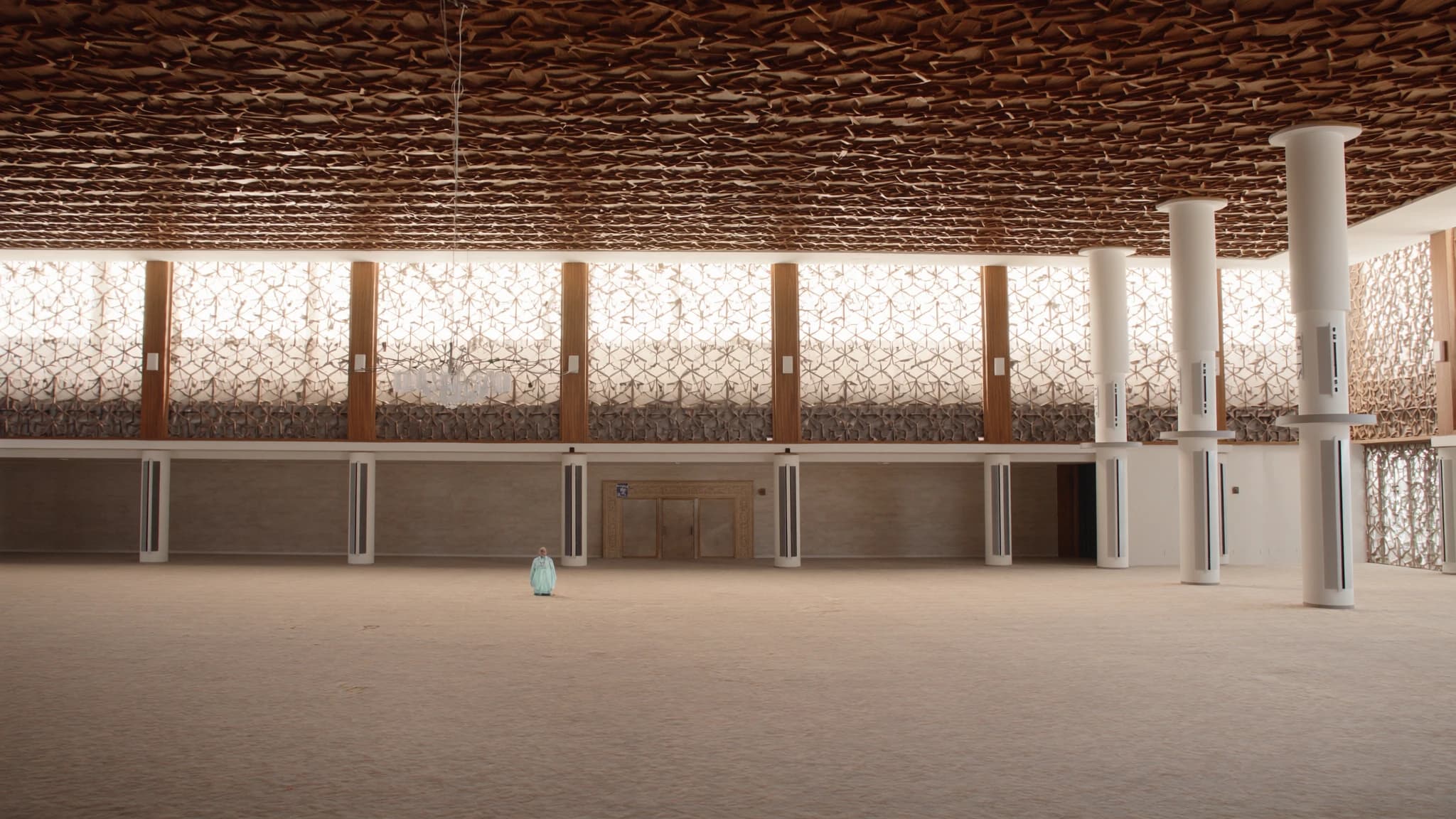
In a mosque, the primary audio requirement is the clear, natural reproduction of the human voice — the imam’s sermon, Quran recitation, and call to prayer. Unlike music venues, where tonal balance and bass response matter, a mosque system must prioritise intelligibility above all else. Reverberation times in large prayer halls can exceed 3–4 seconds, which smears speech and reduces clarity. Standard point-source speakers often fail in such spaces because they excite the room’s reverberant field too aggressively.

The solution lies in directional loudspeakers that concentrate sound onto the listeners while minimising energy directed at walls, ceilings, and floors. This is where column arrays and line-source technology excel. By controlling vertical dispersion, these systems deliver speech directly to the audience with less reverberant build-up, dramatically improving intelligibility scores (STI) even in difficult acoustics.

Column Arrays vs. Traditional Point-Source Speakers for Reverberant Halls

Traditional point-source speakers radiate sound in a wide pattern, causing early reflections from hard surfaces like marble, glass, and concrete — common in mosque architecture. This results in a muddy, echo-laden listening experience. Column arrays, on the other hand, use multiple small drivers arranged vertically to create a narrow, controlled vertical beam. This beam can be aimed at the seating area, reducing the amount of sound hitting the ceiling and rear walls.

For a mosque, a column array is an ideal choice. It provides uniform coverage from front to back without excessive SPL, and its slim profile blends discreetly into the architecture — often painted to match columns or walls. SSOUNDS column array systems are designed with advanced DSP and beam-steering capabilities, allowing the installer to tailor the coverage pattern to the exact room geometry. This means the imam’s voice reaches every worshipper with clarity, even in the most reverberant spaces.

Distributed Coverage: Avoiding Hot Spots and Dead Zones

Large prayer halls often require multiple loudspeaker clusters to cover the entire floor area evenly. A common mistake is using too few speakers at high volume, creating hot spots near the speakers and dead zones at the back. The better approach is a distributed system with many low-level sources placed close to the listeners. This is known as the ‘distributed reinforcement’ method and works exceptionally well in mosques.

SSOUNDS offers compact column arrays and surface-mount loudspeakers that can be spaced along walls or columns, each covering a specific zone. By overlapping coverage gently, the system achieves uniform SPL and high intelligibility without drawing attention to itself. Time alignment and delay settings are critical in such setups, and SSOUNDS DSP platforms include intuitive tools for delay and EQ optimisation, ensuring seamless transitions between zones.

Outdoor and Minaret Audio: Weatherproofing and Long Throw

The call to prayer (adhan) requires loudspeakers that can project clear sound over long distances, often from a minaret or rooftop. Outdoor environments introduce challenges like wind, ambient noise, and weather exposure. For minaret installations, a vertical line array or a weatherproof column array is the standard. These systems provide the necessary reach and directivity to cover the surrounding neighbourhood without excessive spill into unwanted areas.

SSOUNDS outdoor-rated line array and column array enclosures are built with marine-grade plywood, stainless steel hardware, and IP55-rated components. They are designed to withstand extreme heat, humidity, and rain common in many regions. The narrow vertical dispersion also helps reduce noise pollution by keeping sound focused on the target area, respecting local noise regulations and community comfort.

Respectful Aesthetics: Blending Sound with Sacred Architecture

A mosque’s interior is a place of serenity and spiritual focus. Loudspeakers should not be visually intrusive. Column arrays, with their slim, elongated form, can be painted to match the wall or column finish, making them nearly invisible. Some SSOUNDS models offer custom RAL colour matching and grille finishes to blend seamlessly with wood, stone, or decorative elements.

For historic or architecturally sensitive mosques, SSOUNDS also offers low-profile surface-mount speakers and in-wall/in-ceiling options that provide high speech clarity without compromising the visual integrity of the space. The goal is always to serve the audio need while respecting the sanctity and design of the environment.

Does a Column Array Work in a Mosque? — The Engineering Answer

Yes, absolutely. In fact, column arrays are often the best choice for a mosque. Here’s why: their narrow vertical dispersion reduces reverberation, their multiple drivers provide consistent coverage over distance, and their slim profile suits the architecture. SSOUNDS column arrays are designed with high-quality neodymium drivers and advanced DSP that allows precise beam steering and multiple presets for different usage scenarios — from a quiet lecture to a full-capacity Friday prayer.

To answer the question directly: a column array does work in a mosque, and it works better than conventional point-source speakers in nearly every case. The only exception might be very small, acoustically dead rooms where a single high-quality point source could suffice. But for the vast majority of mosque installations, a column array or line array system from SSOUNDS will deliver the best speech intelligibility, coverage, and aesthetic integration.

Frequently asked

Can I use a single column array for a large prayer hall?

It depends on the hall size and shape. For very large halls, multiple column arrays or a distributed system is recommended to ensure even coverage and high intelligibility at every seat. SSOUNDS can design a system tailored to your specific room dimensions.

Are column arrays difficult to install in a mosque?

No. Column arrays are designed for easy wall or column mounting. SSOUNDS provides detailed rigging instructions and support. For best results, professional installation and system tuning are recommended.

How do I protect outdoor speakers from weather?

Choose loudspeakers with an IP55 rating or higher. SSOUNDS outdoor models are built with weather-resistant enclosures, stainless steel hardware, and protective grilles. Regular maintenance, such as checking seals and connections, will extend their life.

Will a column array affect the acoustics of the mosque negatively?

On the contrary, a properly designed column array improves acoustics by reducing reverberant sound. It focuses energy on the listeners, so the room’s natural reverb is less problematic. This actually enhances the listening experience.

Can I connect a column array to my existing amplifier and mixer?

Yes, but for optimal performance, use a DSP-controlled amplifier that matches the loudspeaker’s presets. SSOUNDS systems include DSP presets that optimise the response for speech, so we recommend using our amplifiers or approved processors.

Building or upgrading a system?

SSOUNDS engineers and manufactures professional PA worldwide — from a single room to stadium scale.

Talk to an engineer
Chat on WhatsApp