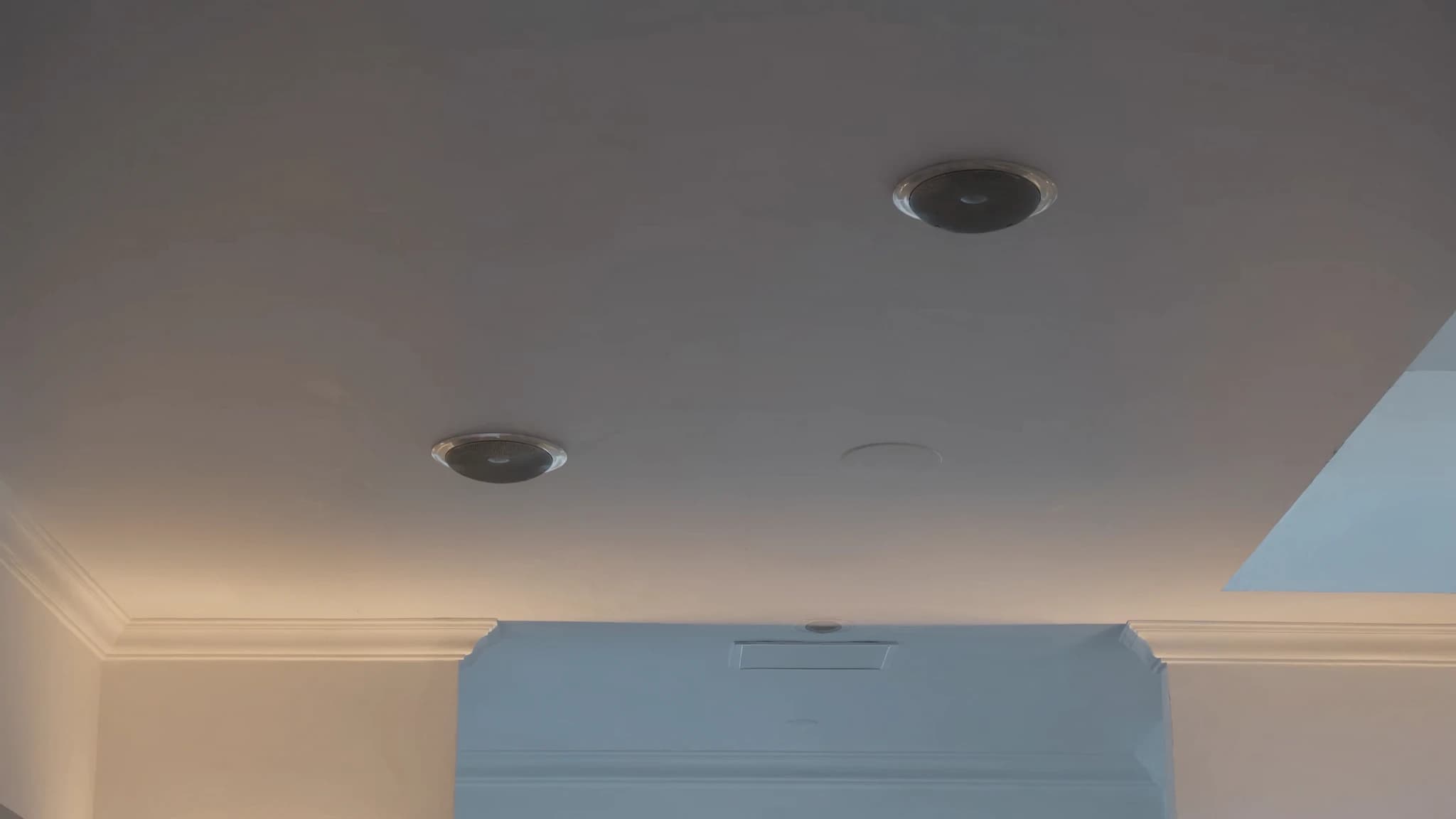
Do In-Ceiling Speakers Need a Backbox?

In-ceiling speakers are a popular choice for distributed audio in homes, offices, and commercial spaces, but the question of whether they need a backbox often divides installers. A backbox—an enclosure mounted behind the speaker—can dramatically affect sound quality, bass response, fire safety, and acoustic isolation between rooms. This guide explains what a backbox does, when it's required by code, and how to choose the right solution for your project.
Key takeaways
- A backbox improves bass response, clarity, and imaging by providing a controlled acoustic load and reducing cavity resonances.
- Fire-rated backboxes are often required by building codes to maintain the ceiling's fire-resistance rating and prevent smoke spread.
- Backboxes provide critical acoustic isolation, preventing sound from traveling between rooms through the ceiling plenum.
- In open-plan spaces or low-criticality installations, backboxes may be omitted, but always check local codes and performance requirements.
- Choose a backbox that matches your speaker's volume requirements and has appropriate fire and acoustic ratings for the application.
- SSOUNDS recommends using backboxes for all in-ceiling speaker installations to ensure optimal sound quality, safety, and compliance.
What Is a Backbox and What Does It Do?
A backbox is a rigid enclosure—typically made of metal, plastic, or fire-rated material—that mounts behind an in-ceiling speaker, creating a sealed air volume behind the driver. Without a backbox, the speaker fires into an open plenum (the space above the ceiling), which acts as an infinite baffle. This has several consequences for sound quality.
First, a backbox provides a controlled air spring that improves low-frequency extension and bass tightness. In an open plenum, low frequencies can cancel or become muddy because the rear wave reflects off ceiling structures and recombines with the front wave. A sealed backbox prevents this cancellation, delivering cleaner, more defined bass.
Second, the backbox physically isolates the speaker from the ceiling cavity, reducing sound transmission into adjacent rooms or floors above. This is critical in multi-tenant buildings, hotels, or offices where noise bleed is unacceptable. Without a backbox, the ceiling plenum acts as a sound bridge, allowing voices and music to travel easily between spaces.
Third, a backbox can improve overall efficiency and power handling by preventing the speaker from 'seeing' an infinite volume, which can cause the driver to exceed its mechanical limits at low frequencies. Many manufacturers specify a minimum enclosure volume for optimal performance—using a backbox ensures the speaker operates within its design parameters.
Fire Rating and Building Code Requirements
In many jurisdictions, building codes require in-ceiling speakers in fire-rated ceilings to be installed with a fire-rated backbox or an equivalent fire-cover assembly. The ceiling itself often provides a fire-resistance rating (e.g., 1-hour or 2-hour), and any penetration—such as a speaker cutout—must maintain that rating. A non-rated backbox or an open back can allow flames and smoke to spread through the plenum, violating code.
Fire-rated backboxes are typically made of heavy-gauge steel with intumescent seals that expand when exposed to heat, sealing the opening and preventing fire from passing through. They are tested and certified to standards such as UL 2043 (for air-handling spaces) or EN 54 (in Europe). In commercial installations, using a non-rated backbox may result in failed inspections and liability issues.
Even in residential settings, many local codes now require fire-rated backboxes when speakers are installed in ceilings that separate living spaces from garages, or in multi-family dwellings. Always check with your local authority having jurisdiction (AHJ) to determine specific requirements. SSOUNDS recommends consulting a licensed professional for code compliance.
Sound Quality: Bass, Clarity, and Imaging
The most noticeable sonic benefit of a backbox is improved bass response. In an open ceiling, low frequencies can become boomy or indistinct because the rear wave reflects off ductwork, joists, and insulation. A backbox provides a consistent acoustic load, allowing the speaker to produce tighter, more controlled bass. For music reproduction, this is essential for achieving a natural, full-range sound.
Backboxes also reduce midrange coloration caused by cavity resonances. The plenum above a ceiling often has irregular dimensions that create standing waves at certain frequencies. These resonances can be excited by the speaker's rear wave, causing peaks and dips in the frequency response that degrade clarity. A well-designed backbox dampens these resonances, resulting in a flatter, more accurate response.
Imaging and soundstage also benefit. When both left and right speakers are mounted in identical backboxes, the acoustic environment is symmetrical, improving stereo imaging. Without backboxes, the plenum's asymmetry can cause channel imbalances and a smeared soundstage. For home theater or high-fidelity installations, backboxes are strongly recommended.
Acoustic Isolation: Preventing Noise Between Rooms
One of the primary reasons to install backboxes is to prevent sound from leaking into adjacent spaces. In open-ceiling plenums, sound from one speaker can travel through the cavity and be heard in the room above or next door. This is particularly problematic in offices, hotels, hospitals, and multi-room residential installations where privacy is important.
A sealed backbox acts as a sound barrier, containing the rear wave and significantly reducing transmission. For maximum isolation, backboxes should be caulked or gasketed at the ceiling cutout to create an airtight seal. Some backboxes also include acoustic damping material (e.g., fiberglass or foam) to absorb internal reflections and further reduce radiated noise.
In critical applications—such as conference rooms, recording studios, or houses of worship—using backboxes in conjunction with decoupling clips or resilient channels can achieve STC (Sound Transmission Class) ratings that meet or exceed building standards. SSOUNDS engineers often specify backboxes with integrated damping to ensure consistent isolation across a project.
When Can You Skip the Backbox?
There are scenarios where a backbox may not be necessary. In open-plan spaces with a single room and no ceiling above (e.g., a warehouse or atrium), there is no adjacent space to isolate, and the plenum is not a concern. Similarly, for low-power background music systems where bass response and isolation are not critical, an open-back installation may be acceptable.
Some in-ceiling speakers are designed with built-in enclosures or 'closed-back' baskets that provide a degree of isolation without a separate backbox. However, these are typically less effective than a dedicated backbox and may not meet fire-rating requirements. Always verify the manufacturer's specifications and local codes before omitting a backbox.
In retrofit situations where access above the ceiling is limited, installers sometimes use 'back cans' that are installed from below. These are essentially backboxes that mount to the ceiling drywall rather than to the structure above. While not as robust as full backboxes, they still provide acoustic and fire benefits. SSOUNDS recommends using a backbox whenever possible to ensure optimal performance and compliance.
Choosing the Right Backbox for Your Speaker
Backboxes come in various sizes and materials. The most common are round or square metal enclosures with pre-cut holes for conduit or cable entry. For fire-rated installations, look for backboxes with UL or EN certification. For acoustic performance, choose a backbox with internal damping and a volume that matches the speaker's recommended enclosure size.
Some backboxes are designed to fit specific speaker models, while others are universal. Universal backboxes often include adjustable brackets or mounting rings to accommodate different cutout diameters. Ensure the backbox depth is compatible with the ceiling cavity—some plenums are too shallow for deep backboxes, requiring a low-profile model.
SSOUNDS offers a range of backbox solutions engineered to complement our in-ceiling speaker systems, ensuring consistent acoustic performance and code compliance. Our engineering team can assist with specifying the correct backbox for your project, whether it's a single room or a large-scale commercial installation.
Frequently asked
Can I install in-ceiling speakers without a backbox?
Yes, but it depends on the application. For background music in a single room with no fire-rating concerns, it may be acceptable. However, for best sound quality, bass response, and code compliance, a backbox is strongly recommended.
Do backboxes affect the speaker's frequency response?
Yes, positively. A backbox provides a consistent acoustic load, improving low-frequency extension and reducing midrange coloration caused by cavity resonances. The result is tighter bass and clearer overall sound.
Are fire-rated backboxes required by law?
In many commercial and multi-family residential buildings, yes. Ceilings with a fire-resistance rating must maintain that rating when penetrated by speakers. Fire-rated backboxes are designed to restore the rating. Always consult local building codes.
Can I use a plastic backbox instead of metal?
Plastic backboxes are lighter and easier to install, but they may not meet fire-rating requirements and can resonate, affecting sound quality. Metal backboxes are generally preferred for acoustic performance and fire safety.
How do I install a backbox in an existing ceiling?
Retrofit backboxes are available that mount from below the ceiling. They typically attach to the drywall with clamps or screws and seal with gaskets. Ensure the backbox is properly sealed to maintain acoustic isolation and fire rating.
Building or upgrading a system?
SSOUNDS engineers and manufactures professional PA worldwide — from a single room to stadium scale.