Skip to content

The Best Ceiling Speakers: A Complete Buyer's Guide

The Best Ceiling Speakers: A Complete Buyer's Guide

Choosing the right ceiling speakers for your commercial or residential installation involves more than just picking a model that fits the hole. From distributed audio systems in retail spaces to high-intelligibility paging in offices, the decisions around impedance, tap settings, coverage spacing, and fire rating can make or break a project. This guide walks through the critical engineering criteria and explains how SSOUNDS commercial ceiling range delivers premium performance for demanding installations.

Key takeaways

  • In-ceiling speakers offer discreet aesthetics and uniform coverage, ideal for commercial distributed audio.
  • 70V/100V constant-voltage systems are standard for multi-speaker installations; choose tap settings based on desired SPL and amplifier power.
  • Coverage spacing formula: max spacing = 2 × (ceiling height - ear height) × tan(dispersion/2); overlap by 50% for smooth coverage.
  • Fire-rated speakers with EN 54-24 certification are mandatory for voice evacuation systems in many jurisdictions.
  • SSOUNDS commercial ceiling range combines high-fidelity drivers, multiple tap options, and EN 54 models for premium performance and safety.
  • Always simulate coverage and calculate total power draw to ensure system reliability and intelligibility.

In-Ceiling vs. Surface-Mount: Matching the Aesthetic and Acoustic Requirements

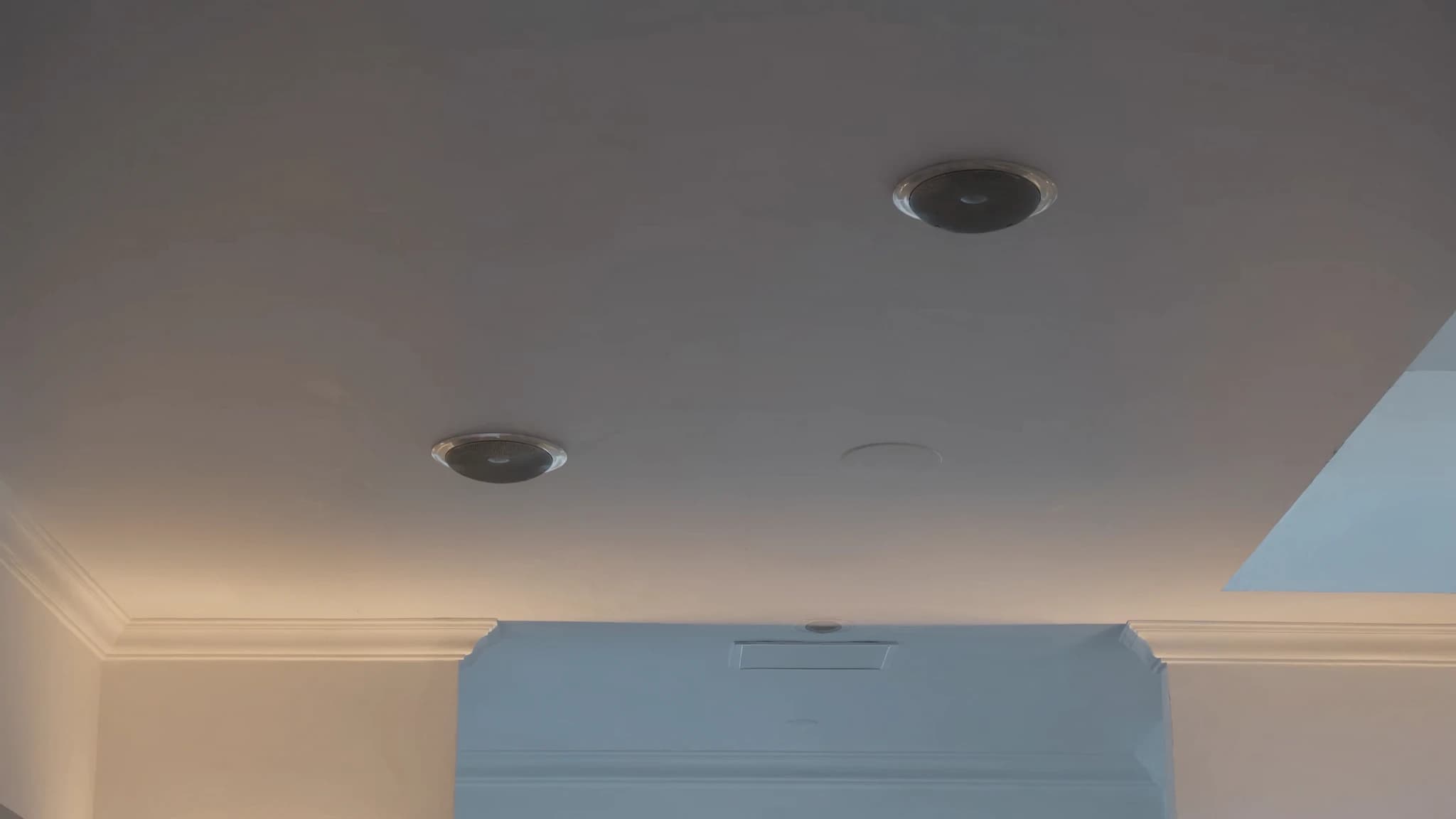
In-ceiling speakers are designed to be flush-mounted into a ceiling tile or drywall, offering a discreet, low-profile appearance that blends with the architecture. They are ideal for environments where visual clutter must be minimised, such as corporate lobbies, restaurants, retail stores, and conference rooms. Surface-mount speakers, on the other hand, are attached to the ceiling or wall and are more visible; they are often used in warehouses, industrial spaces, or where ceiling plenum access is limited.

Acoustically, in-ceiling speakers can provide more uniform coverage when properly spaced, as the sound radiates downward in a controlled pattern. Surface-mount speakers may offer more directivity options but can create hot spots and dead zones if not carefully aimed. For most commercial distributed audio systems, in-ceiling speakers are the preferred choice for their blend of aesthetics and performance. SSOUNDS commercial ceiling range is engineered to deliver consistent, wide-dispersion coverage with minimal colouration, making them suitable for both music and speech applications.

70V/100V vs. Low-Impedance: Understanding the Electrical Differences

The choice between 70V/100V (constant-voltage) and low-impedance (typically 8Ω or 4Ω) systems is fundamental in ceiling speaker installations. Constant-voltage systems use a transformer at each speaker to step up the voltage, allowing long cable runs with minimal loss and easy paralleling of multiple speakers. This is the standard for commercial distributed audio where many speakers are driven from a single amplifier. The tap settings (e.g., 1W, 2W, 4W, 8W) let you adjust the power delivered to each speaker, balancing SPL and coverage.

Low-impedance systems are more common in residential or small-scale installations where cable runs are short and the amplifier can handle the total load. They offer better damping factor and potentially higher fidelity, but require careful impedance matching and heavier gauge wire. For most commercial installations, 70V/100V is the practical choice. SSOUNDS ceiling speakers include high-quality transformers with multiple tap settings, ensuring compatibility with standard constant-voltage amplifiers while maintaining audio quality.

Tap Settings and Power Tapping: Getting the SPL Right

Tap settings on a 70V/100V speaker determine how much power the speaker draws from the amplifier line. Common taps are 1W, 2W, 4W, 8W, and sometimes 16W or 32W. The correct tap depends on the desired sound pressure level (SPL) at the listening position, the number of speakers on the line, and the amplifier's total power. A rule of thumb: for background music, 1-2W per speaker is often sufficient; for foreground music or paging, 4-8W may be needed.

It's important to calculate the total power draw (sum of all tap settings) and ensure it does not exceed 80% of the amplifier's rated output for headroom. SSOUNDS ceiling speakers feature clearly labelled, selectable taps that allow installers to fine-tune each zone. The transformers are designed for low insertion loss and wide bandwidth, preserving clarity even at low tap settings.

Coverage and Spacing: The Science of Even Dispersion

Ceiling speaker coverage is determined by the speaker's dispersion angle (typically 90° to 150° conical) and the ceiling height. The goal is to achieve uniform SPL across the listening plane (usually ear height, 1.2-1.5 m above floor). A common spacing formula: maximum spacing = 2 × (ceiling height - ear height) × tan(dispersion angle/2). For a 90° speaker at 3m ceiling height, spacing would be about 4.5m.

Overlapping coverage by 50% (i.e., spacing equal to the coverage diameter at ear height) ensures smooth transitions and avoids dead spots. SSOUNDS engineers use advanced simulation tools to model coverage patterns, and our ceiling speakers are designed with controlled directivity to minimise reflections and off-axis colouration. For critical installations, we recommend a site survey and acoustic modelling to optimise speaker placement.

Fire-Rated and EN 54 Compliance: Safety in Commercial Installations

In many commercial buildings, ceiling speakers must meet fire safety regulations, particularly for voice evacuation systems. EN 54-24 is the European standard for loudspeakers for voice alarm systems, specifying performance under fire conditions (e.g., operation at elevated temperatures, mechanical integrity). Fire-rated speakers often include a ceramic terminal block, high-temperature voice coil, and a metal back can to contain flames and prevent the spread of fire through the ceiling plenum.

SSOUNDS offers a range of ceiling speakers designed to meet EN 54-24 requirements, with robust construction and certified components. These models are suitable for life safety applications, ensuring that emergency announcements remain intelligible during a fire. For non-life-safety installations, standard ceiling speakers with plenum-rated cables may suffice, but always check local building codes.

Practical Selection Criteria for Commercial Installations

When selecting ceiling speakers for a commercial project, start by defining the application: background music, foreground music, paging, or voice alarm. Determine the ceiling height, room dimensions, and desired SPL. Calculate the number of speakers needed using coverage spacing formulas, then choose a tap setting that provides adequate level without overdriving the amplifier. Consider the frequency response: a wider bandwidth (e.g., 70 Hz - 20 kHz) is better for music, while speech-only systems can use narrower bandwidth.

Also evaluate the speaker's sensitivity (dB SPL at 1W/1m) — higher sensitivity means more output with less power. Look for models with low distortion and consistent off-axis response. SSOUNDS commercial ceiling speakers are built with high-quality drivers, robust enclosures, and easy installation features like quick-fit mounting and tool-less tap selection. Our range includes models optimised for both music and speech, with options for 70V/100V and low-impedance operation, and EN 54 certified versions for life safety.

Frequently asked

What is the difference between 70V and 100V systems?

70V and 100V are both constant-voltage standards. 100V systems are more common in Europe and allow higher power delivery over longer distances with less loss, but require speakers with 100V transformers. 70V is prevalent in North America. Both work similarly; the choice depends on regional practice and amplifier compatibility.

How do I determine the correct tap setting for my ceiling speakers?

Start with the desired SPL at ear level. For background music, 1-2W per speaker is typical; for foreground or paging, 4-8W. Sum all tap settings and ensure the total is ≤80% of the amplifier's rated output. Use a sound level meter during commissioning to adjust.

Can I mix 70V and low-impedance speakers on the same amplifier?

No, you cannot mix them on the same amplifier channel. Use a 70V amplifier for constant-voltage speakers and a standard low-impedance amplifier for 8Ω speakers. Some amplifiers offer switchable outputs, but never connect both types simultaneously.

Are all ceiling speakers fire-rated?

No, only speakers specifically designed and certified to standards like EN 54-24 are fire-rated. Standard ceiling speakers may use plastic components that can melt or burn. For life safety systems, always use certified models. SSOUNDS offers EN 54 certified options for such applications.

What ceiling height is best for ceiling speakers?

Typical ceiling heights range from 2.4m to 4.5m. Lower ceilings require tighter spacing (e.g., 2-3m apart) to avoid hot spots. Higher ceilings allow wider spacing but may need higher tap settings to achieve sufficient SPL at ear level. Always calculate coverage based on the specific height.

Building or upgrading a system?

SSOUNDS engineers and manufactures professional PA worldwide — from a single room to stadium scale.

Talk to an engineer
Chat on WhatsApp