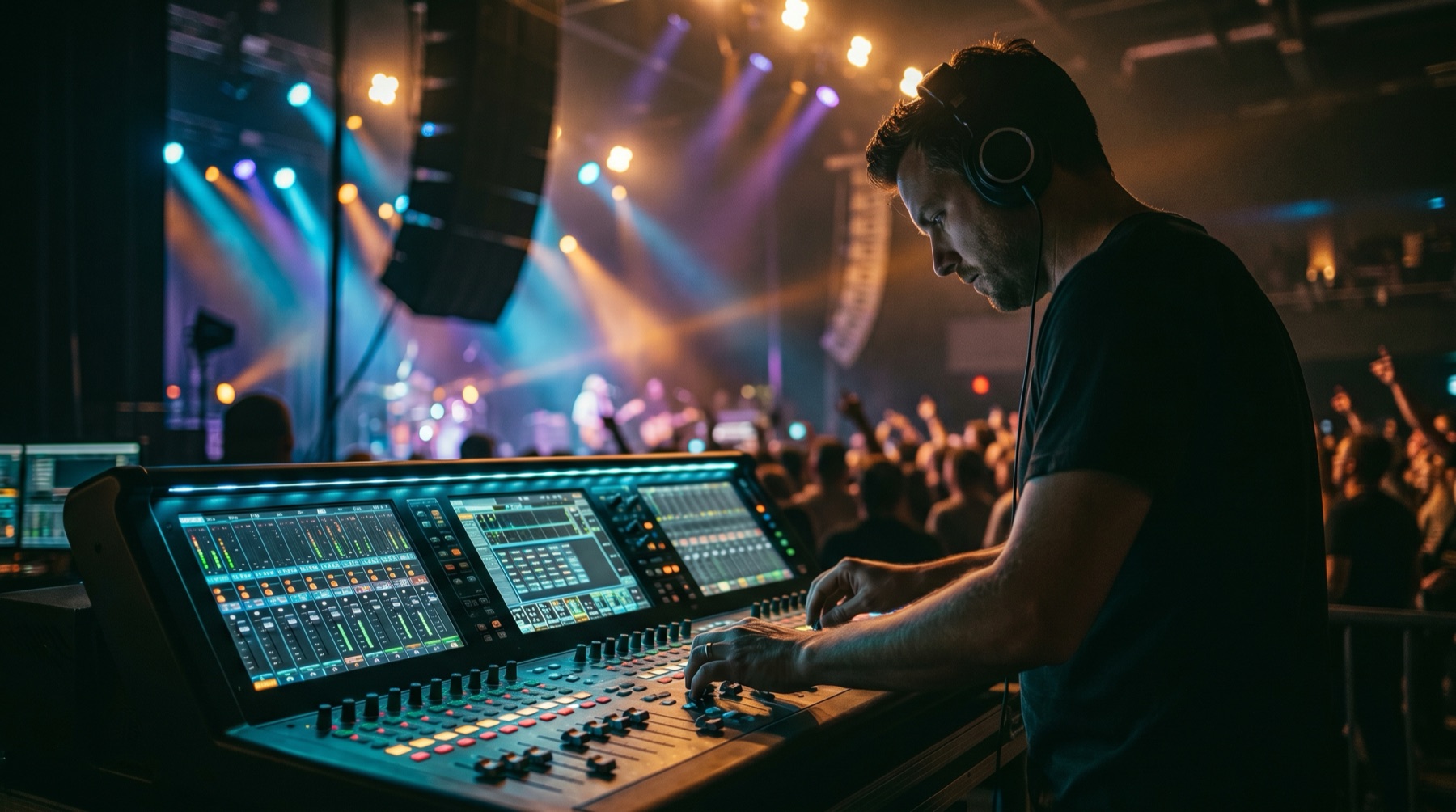
The professional audio industry stands at a threshold. For decades, system engineers have relied on experience, ear training, and physics-based simulation tools to deliver consistent sound across thousands of venues. But the complexity of modern live events, with immersive arrays, multi-zone coverage, and ever-tighter production schedules, is pushing the limits of what manual optimisation can achieve. Enter artificial intelligence and machine learning. These technologies are not science fiction; they are already reshaping how we model acoustics, tune DSP, and predict system performance. At SSOUNDS, we see AI as the next logical step in our engineering heritage: a tool to augment human expertise, not replace it.
One of the most promising applications is AI-assisted acoustic modelling. Traditional ray-tracing and finite-element methods require detailed venue geometry, material absorption coefficients, and hours of computation. Machine learning can accelerate this by learning from thousands of existing acoustic simulations. A neural network trained on measured impulse responses can predict coverage patterns, early reflections, and bass build-up in near real-time. For touring engineers, this means arriving at a new arena and having an optimised starting point within minutes, not hours. The system learns from past deployments in similar spaces, adapting to the unique quirks of each room. SSOUNDS is exploring how our line array modelling tools can integrate such predictive models, giving engineers a powerful shortcut without sacrificing accuracy.
ML-tuned DSP and loudspeaker presets represent another frontier. Today, DSP presets are often hand-tuned by R&D teams for generic use cases. But every venue, every rigging position, every audience shape is different. Machine learning can analyse measurement data, from SMAART traces, FIR coefficients, or even live microphone feeds, and suggest DSP adjustments in real time. Imagine a system that listens to its own output during soundcheck, identifies comb filtering or phase anomalies, and proposes EQ or delay changes to the engineer. The engineer remains in control, but the AI handles the tedious number-crunching. At SSOUNDS, we are developing algorithms that learn from our own loudspeaker designs, ensuring that any ML-generated preset respects the physical limits of the drivers and amplifiers. The result is faster, more consistent tuning, especially for less experienced operators.
Predictive simulation goes a step further. Instead of reacting to problems, AI can forecast them. For example, a machine learning model trained on weather data, crowd density, and historical system logs can predict how a PA will behave under load, whether amplifiers will thermal-throttle, whether subwoofer coupling will change as humidity rises, or whether coverage will shift as the audience fills in. This allows proactive adjustments: a slight array tilt before the show, a limiter threshold change, or a delay tower EQ tweak. For festivals and outdoor events, where conditions change by the hour, this capability is transformative. SSOUNDS believes that the next generation of system controllers will include such predictive modules, giving engineers a dashboard of likely outcomes rather than a rearview mirror of problems.
Automation of repetitive tasks is perhaps the most immediate benefit. Ringing out monitors, aligning subwoofer arrays, and verifying coverage with a measurement mic are time-consuming and prone to human error. AI can automate the data collection and initial analysis, presenting the engineer with a clean set of actionable insights. For example, an ML algorithm can identify the optimal subwoofer placement by simulating hundreds of positions in seconds, or automatically detect feedback frequencies and suggest notch filters. This frees the engineer to focus on creative decisions, the mix, the artistic intent, the interaction with the artist. At SSOUNDS, we are integrating such automation into our system design software, so that the mundane tasks are handled by algorithms while the human remains the final decision-maker.
But where do humans stay essential? Everywhere that matters. AI is a pattern-matching engine, not a creative force. It cannot feel the energy of a crowd, interpret a producer’s subtle request, or make a split-second decision when a microphone falls off a stand. It cannot understand the emotional arc of a performance or the unspoken communication between a front-of-house engineer and a monitor engineer. AI can suggest, but it cannot commit. The human ear remains the ultimate arbiter of good sound. Moreover, AI models are only as good as their training data. A model trained on pop concerts may fail at a classical orchestral reinforcement. A model trained on indoor arenas may falter in a cathedral. Engineers must understand the limitations of the tool and override it when necessary. At SSOUNDS, we design our AI features to be transparent and explainable, the engineer can see why a recommendation was made and choose to accept, modify, or reject it.
Another critical human role is in system design and deployment. AI can optimise within known parameters, but it cannot invent a novel array configuration or adapt to a completely unexpected venue shape. The creative leap, the decision to fly a side hang, to use a cardioid sub array, to place delays on balcony rails, remains the domain of the experienced designer. AI is a powerful assistant, but it is not a replacement for years of listening, failing, and learning. The best outcomes will come from a partnership: the AI handles the data, the human handles the artistry.
Looking ahead to the next decade, we at SSOUNDS are investing heavily in AI and ML research. Our engineering team collaborates with academic institutions and develops proprietary models trained on our own loudspeaker measurements and real-world deployment data. We are committed to releasing tools that are practical, reliable, and respectful of the engineer’s workflow. We will not release a black box that tunes a system without explanation. Instead, we will release intelligent assistants that learn from you, adapt to your preferences, and make you better at your craft.
The future of live sound is not a world without engineers. It is a world where engineers are supercharged by AI, where they can achieve in minutes what once took hours, and where they can focus on the magic that only a human can create. The next frontier is not about replacing the human ear; it is about giving it more time to listen.