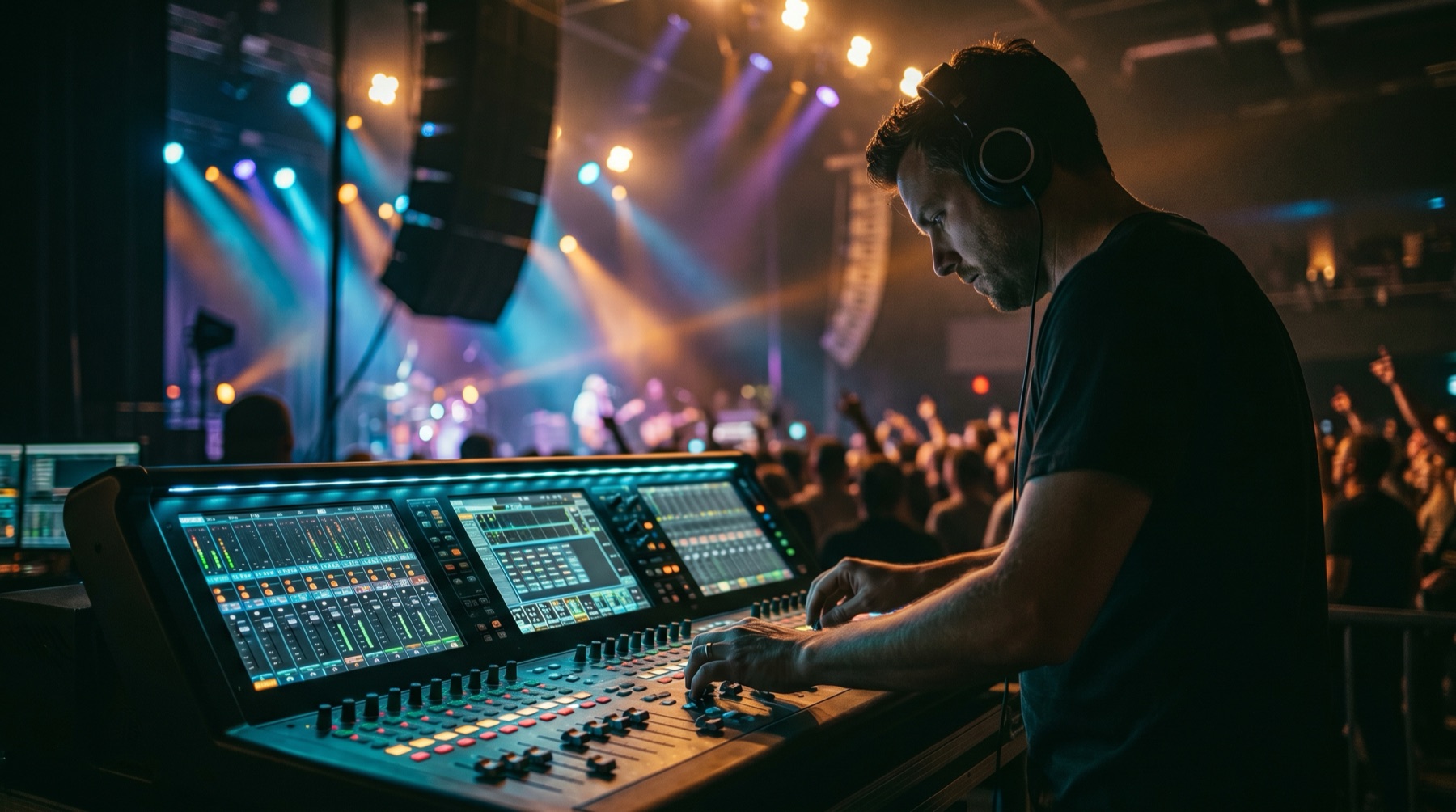
Feedback is the uninvited guest at every live event. It starts as a whisper, builds into a howl, and before you can grab the fader, the audience is wincing. For decades, engineers fought it with graphic EQs, notch filters, and careful mic placement. Now a new tool is entering the mix: AI-driven automatic feedback suppression. In 2022, this technology is mature enough to be a practical asset on tours, in houses of worship, and on speech stages. SSOUNDS champions this approach with Alpha Sound AI, a system that uses real-time spectral analysis, adaptive notch filtering, and machine learning to detect ringing before it becomes audible. But how does it work, where does it shine, and what are its limits? Let's dive in.
At the core of Alpha Sound AI is continuous spectral analysis. The system monitors the incoming audio signal across the frequency spectrum, looking for telltale signs of feedback buildup. Traditional feedback suppressors use fixed notch filters that are triggered only after feedback has already started. Alpha Sound AI is different. It employs machine learning models trained on thousands of hours of live sound data to recognize the subtle pre-ringing patterns that precede a full-blown howl. These patterns include rapid level increases in narrow frequency bands, phase shifts, and harmonic correlations that human ears can't detect in real time. When the AI identifies a potential feedback frequency, it applies a precise, adaptive notch filter that attenuates only that narrow band, often by just a few decibels, before the feedback becomes audible. The filter is dynamic, it adjusts its depth and width based on the changing acoustic environment, and it releases when the risk passes.
This approach has several advantages. First, it preserves the natural sound of the program material. Unlike a broad graphic EQ cut that removes musical content, Alpha Sound AI's filters are surgical. They target only the offending frequency, leaving adjacent harmonics untouched. Second, the system learns. Each venue, each mic placement, each room mode is unique. The AI adapts in real time, building a profile of the acoustic space and updating its filter set as conditions change, for example, when a speaker moves closer to a monitor or when the room fills with people. Third, it works proactively. The goal is not to catch feedback after it starts but to prevent it from starting at all.
Where does AI feedback suppression help most? In worship settings, it is a game-changer. Houses of worship often have multiple open microphones on a stage, with speakers and worship leaders moving freely. The acoustics can be challenging, live rooms with hard surfaces, or overly dry spaces with poor monitoring. Alpha Sound AI can manage the gain-before-feedback margin across dozens of wireless mics without requiring constant manual EQ adjustments. The result is clearer speech and vocals, fewer interruptions, and less engineer fatigue during long services.
Speech applications are another natural fit. Corporate events, conferences, and lecture halls often rely on lavalier and handheld microphones with varying placement. A speaker who turns their head or gestures can create feedback loops. AI suppression catches these transient events instantly, allowing the engineer to focus on content and mix rather than firefighting. In monitor mixing, where feedback is most common, Alpha Sound AI can be applied to individual monitor mixes. The system learns the specific feedback modes of each wedge or in-ear mix and applies filters only where needed, preserving the mix's integrity.
But AI is not magic, and it has limits. The most important limit is that it cannot fix bad gain structure. If the system gain is too high, or if microphones are placed directly in front of loudspeakers, no amount of intelligent filtering will prevent feedback, it will simply saturate the system with many narrow cuts, potentially degrading sound quality. Alpha Sound AI works best when the engineer has already established a solid foundation: proper mic technique, appropriate gain staging, and sensible speaker placement. The AI is an assistant, not a replacement for fundamentals.
Another limit is that aggressive filtering can sometimes affect musical content if the feedback frequency coincides with a fundamental note or harmonic. While Alpha Sound AI's filters are narrow, they are not infinitely narrow. In extreme cases, a sustained note from a guitar or synth might trigger a filter if the system misinterprets it as pre-feedback. The best practice is to use the AI as a safety net, not a primary EQ. Set your system up with good gain structure and basic EQ first, then engage the AI with conservative sensitivity settings. Let it handle the unexpected, but don't rely on it to fix a fundamentally unstable system.
Best practice for using Alpha Sound AI in a live environment starts with system tuning. Ring out the room manually using a graphic EQ or parametric EQ before turning on the AI. This removes the most obvious feedback modes and reduces the workload on the AI. Then, set the AI's detection threshold to a moderate level, too sensitive and it may over-filter; too insensitive and it won't catch fast transients. During soundcheck, walk the stage with a live mic to let the AI learn the space. Many systems, including Alpha Sound AI, have a learning mode that builds a baseline. After that, monitor the filter activity on the software interface. If you see many filters engaging, it is a sign that your gain structure or mic placement needs attention. Adjust accordingly.
In practice, I have found that Alpha Sound AI adds about 3 to 6 dB of usable gain-before-feedback in most rooms, sometimes more in challenging acoustics. That extra headroom can be the difference between a clear mix and a brittle one. But the real value is peace of mind. During an address or a critical speech, you know that the system is watching for feedback in the background, allowing you to focus on the art of mixing rather than the fear of the howl.
AI-driven feedback suppression is not a gimmick. In 2022, it is a practical, reliable tool that enhances the live sound engineer's workflow. SSOUNDS' Alpha Sound AI represents the state of the art: real-time spectral analysis, adaptive notch filtering, and machine learning that detects ringing before it builds. Use it wisely, respect its limits, and always remember that good gain structure and mic technique still matter. The AI is your co-pilot, not the pilot. With that mindset, you will get more gain, fewer howls, and a better experience for your audience.