Off-Grid and Solar Power for Live Events and AV
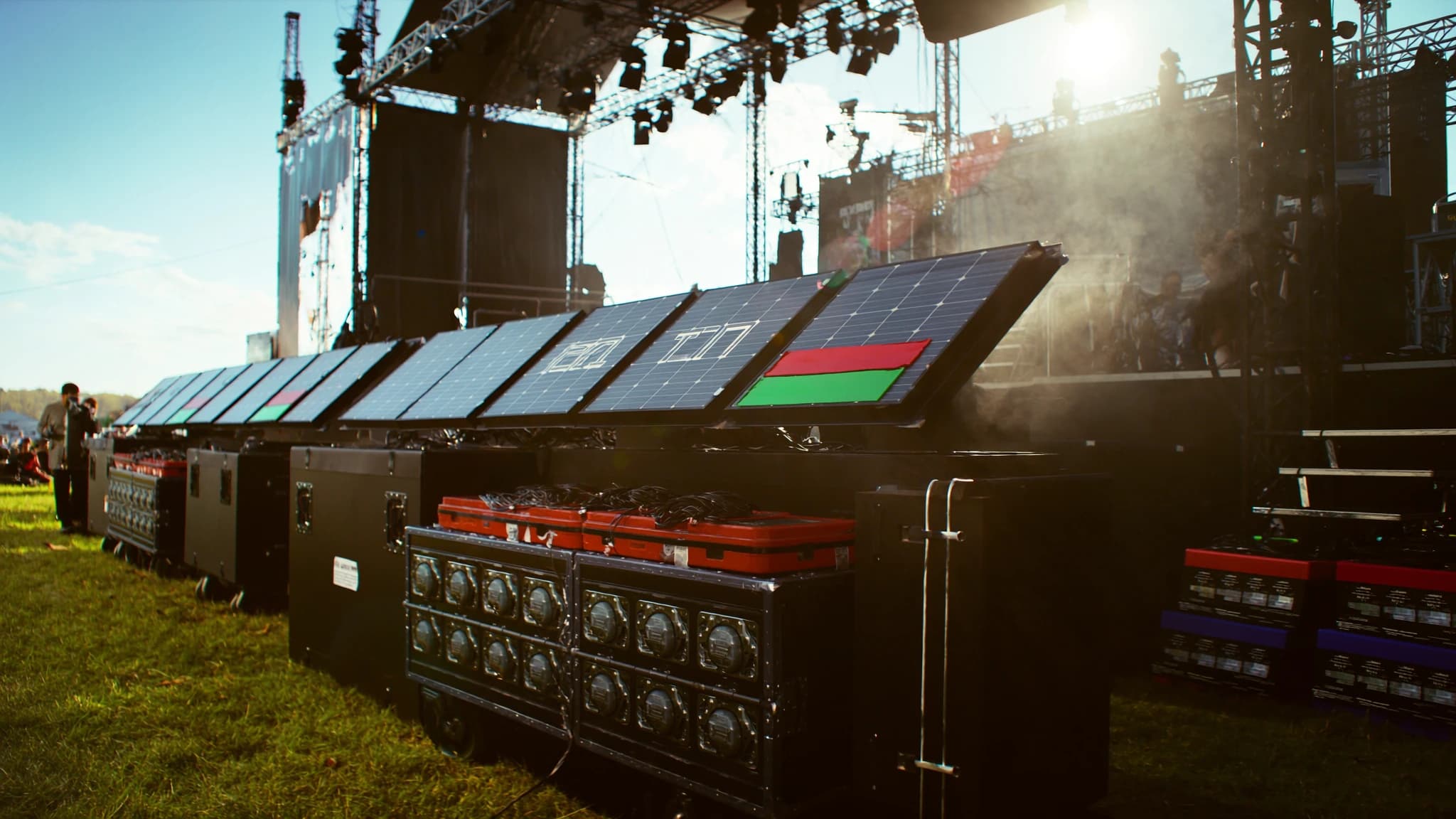
Off-grid power is transforming live events, enabling productions in remote locations while reducing carbon footprints. For AV professionals, understanding solar arrays, battery storage, and hybrid generator setups is essential, especially for power-hungry audio systems. This guide covers the realities of powering a stage with solar, including load sizing, inrush currents, and clean power requirements, and explains how SSOUNDS loudspeakers can run on solar via proper battery and inverter supply.
Key takeaways
- Solar+battery systems can power small to medium audio stages, but large events typically require hybrid generator backup.
- Audio loads have low continuous draw but high peak and inrush demands; size inverter and battery for peaks, not just average.
- Pure sine wave inverters are mandatory for clean amplifier power; modified sine wave can cause noise and damage.
- SSOUNDS loudspeakers and amplifiers work on solar when paired with properly sized battery and inverter systems.
- Use a power meter to measure real-world draw from your specific rig, ratings are often misleading.
- Lithium iron phosphate (LiFePO4) batteries are the best choice for cycle life, weight, and depth of discharge.
Understanding Off-Grid Power Components
Off-grid event power typically combines three elements: solar panels (PV arrays), battery energy storage systems (BESS), and an inverter/charger. Solar panels convert sunlight into DC electricity, which charges batteries. The inverter converts DC to clean AC power for audio gear. For events, a hybrid generator+battery setup is common: batteries handle base loads and peaks, while a generator recharges batteries or supplements high-demand periods.
Battery technology has advanced rapidly: lithium iron phosphate (LiFePO4) is now standard for its high cycle life, safety, and depth of discharge (up to 95%). Lead-acid remains cheaper but heavier and less efficient. For live sound, the inverter must produce a pure sine wave, modified sine wave can cause hum, distortion, or damage to amplifiers and DSP.
Sizing for Audio Loads: Continuous vs. Peak Draw
Audio loads are deceptive: a loudspeaker system's continuous power draw is much lower than its peak or program rating. For example, a large line array cabinet rated at 2000W peak might draw only 200-400W continuous during normal operation. However, transient peaks (bass hits, snare cracks) can demand 2-3x the continuous current for milliseconds. Amplifiers also have inrush current at power-on, often 2-5x the running current for a few cycles.
To size a solar+battery system, start with the total continuous draw of all audio gear (amplifiers, DSP, monitors, etc.) and add 20-30% headroom. Then multiply by the event duration to get battery capacity in kWh. For peak loads, the inverter must handle short bursts, a 10kW inverter can often handle 20kW peaks for a few seconds. SSOUNDS engineers recommend using a power meter (e.g., a P3 Kill A Watt) on your actual rig to measure real-world draw.
Can Solar Realistically Run a Stage?
Yes, but with caveats. A typical small stage (2-4 speakers, subs, monitors, mixer, lights) might draw 1-3kW continuous. To run 8 hours on solar alone, you need 8-24kWh of battery storage and enough solar panels to recharge during daylight. In sunny conditions, a 5kW solar array can generate 20-30kWh per day, enough for a small to medium event. However, clouds, rain, or evening shows require larger battery banks or a generator backup.
For large-scale events with multiple line arrays and subwoofers (e.g., 20-40kW continuous), solar-only becomes impractical without massive arrays (50-100kW+) and megawatt-hour batteries. In those cases, a hybrid approach is best: solar+battery for base loads and a generator for peak demands or recharging. SSOUNDS has supported events where solar provided 60-80% of total energy, with a diesel generator as a backup.
Clean Power and Inrush: What Amplifiers Need
Amplifiers are sensitive to power quality. Voltage sags, frequency shifts, or harmonic distortion can cause erratic behavior, reduced output, or damage. A pure sine wave inverter is non-negotiable. Additionally, amplifiers have high inrush current when powered on, especially large class-D amps with large capacitors. To avoid tripping breakers, soft-start circuits or sequential power-up (delaying each amp by 1-2 seconds) is recommended.
SSOUNDS amplifiers are designed with robust power supplies that tolerate moderate voltage fluctuations (±10%) and include inrush limiting. However, for off-grid setups, we recommend oversizing the inverter by 25-50% to handle transient peaks. A 15kVA inverter is often sufficient for a 10kW continuous audio load. Battery voltage must also be stable, lithium batteries maintain voltage better than lead-acid under load.
SSOUNDS Speakers on Solar: Real-World Feasibility
Yes, SSOUNDS loudspeakers can run on solar, they are no different from any professional audio system in this regard. The key is a properly sized battery and inverter. For example, a small SSOUNDS point-source system (two tops, two subs, one amplifier) might draw 500W continuous. A 2kWh LiFePO4 battery and 1.5kW pure sine wave inverter can run it for 3-4 hours, recharged by 400W of solar panels in 5-6 hours of sun.
For larger SSOUNDS line array systems, the same principles apply: calculate total continuous draw, add headroom, and size batteries and solar accordingly. SSOUNDS' efficient class-D amplification helps keep power consumption lower than older designs. We have successfully powered SSOUNDS systems at outdoor festivals using a 10kW solar array and 40kWh battery bank, supplemented by a small generator for cloudy days.
Practical Tips for Off-Grid AV Power
1) Use a power audit: measure each device's draw with a wattmeter during a rehearsal. 2) Invest in a quality inverter with low THD (<3%) and surge rating. 3) Separate audio and lighting circuits to avoid noise from dimmers. 4) Use battery management systems (BMS) to prevent over-discharge. 5) Have a backup generator for critical events, solar is variable. 6) Consider portable solar generators (e.g., EcoFlow, Goal Zero) for small setups, but for larger systems, custom-built racks are more cost-effective.
SSOUNDS offers technical support for off-grid setups, including load calculations and inverter recommendations. Our systems are designed for reliability in challenging environments, from remote African villages to European festivals. With proper planning, solar-powered audio is not only possible but increasingly practical.
Frequently asked
Can I run a full PA system on solar panels alone?
Yes, for small to medium systems (up to ~3kW continuous) with sufficient battery storage and solar array. For large line arrays, a hybrid generator+battery setup is more realistic.
What size inverter do I need for a typical live sound rig?
Calculate total continuous draw (e.g., 2kW) and multiply by 1.5-2 for peak headroom. A 4-5kVA pure sine wave inverter is common for small stages; 10-20kVA for larger systems.
Do SSOUNDS amplifiers have special power requirements?
No, they work on standard AC power (110-240V, 50/60Hz) with a tolerance of ±10%. They include inrush limiting, but we recommend sequential power-up for multiple amps.
How much solar panel capacity do I need for a day-long event?
As a rule of thumb, 1kW of solar panels generates 4-6kWh per day in good sun. For a 2kW continuous load running 8 hours (16kWh), you'd need at least 3-4kW of panels and a 20kWh battery bank.
Can I use a car battery to power my PA?
Not recommended. Car batteries are designed for short high-current bursts, not deep cycling. Use deep-cycle lithium or lead-acid batteries designed for solar storage.
Building or upgrading a system?
SSOUNDS engineers and manufactures professional PA worldwide, from a single room to stadium scale.