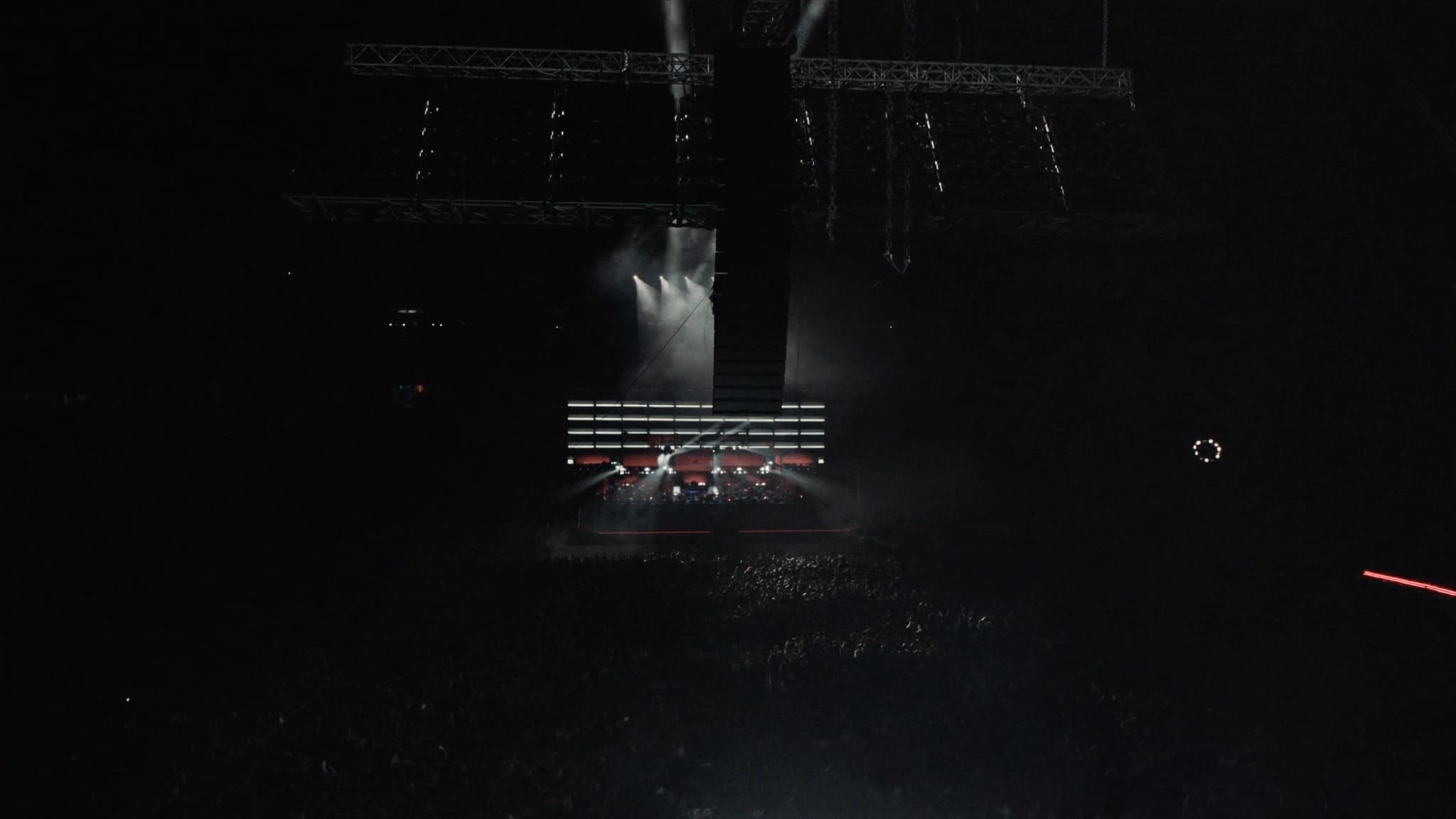
Stadium and Arena Sound Design Fundamentals

Designing sound reinforcement for stadiums and arenas presents unique challenges: vast distances, high ambient noise, and demanding intelligibility requirements. This guide covers the core principles—long-throw line arrays, delay ring deployment, and coverage optimization—and explains how SSOUNDS engineering delivers world-class results at scale.
Key takeaways
- Stadium sound requires long-throw line arrays that maintain pattern control and SPL over 100+ meters.
- Delay rings are essential for covering rear and side seating, but require precise time alignment to avoid comb filtering.
- Intelligibility (STI > 0.5) is the key metric; speech and music modes optimize the system for different content.
- Advanced DSP with FIR filters and sample-accurate delays is critical for seamless coverage across multiple zones.
- Acoustic simulation (EASE, AI-assisted modeling) reduces design risk and ensures predictable performance.
- SSOUNDS provides integrated, weather-resistant systems with global support for permanent stadium installations.
Understanding the Scale Challenge
Stadiums and arenas are among the most acoustically demanding venues. With seating capacities from 10,000 to over 100,000, the sound system must cover distances exceeding 100 meters while maintaining uniform SPL and clarity. Reverberation times can be long (2-5 seconds in enclosed arenas, less in open stadiums), and ambient noise from crowds, HVAC, and events can exceed 90 dB SPL. The goal is to deliver speech intelligibility (STI > 0.5) and music clarity across every seat, from the front row to the top tier.
To overcome these obstacles, system designers rely on three pillars: line array technology for controlled directivity, delay rings to extend coverage without comb filtering, and advanced DSP to align timing and frequency response. SSOUNDS integrates all three into turnkey stadium solutions, backed by AI-assisted prediction and machine-learning-tuned presets.
Long-Throw Line Arrays: The Backbone of Stadium Sound
A line array is a vertical column of loudspeaker elements that couple acoustically to produce a coherent cylindrical wavefront, which decays at only 3 dB per doubling of distance (vs. 6 dB for a point source). This property is essential for covering long distances with minimal SPL loss. However, not all line arrays are equal: true long-throw designs require high-power drivers, narrow vertical dispersion (typically 0.5° to 1° per element), and precise mechanical splay angles to maintain pattern control to the lowest frequencies.
SSOUNDS line array systems are engineered for this exact application. Each enclosure features proprietary waveguide technology that ensures consistent coverage from 80 Hz upward, with vertical splay adjustments as fine as 0.1°. The result is a system that can project clear, intelligible audio to the farthest seats without excessive spill into the playing field or upper stands. For the largest venues, SSOUNDS offers dedicated long-throw arrays with extended bass response and 140+ dB peak SPL capability.
Delay Rings: Extending Coverage Without Compromise
Even the best line array cannot cover a 360-degree stadium from a single hang point. Delay rings—secondary clusters of loudspeakers positioned at increasing distances from the main stage—are used to cover rear and side seating areas. The critical challenge is time alignment: each delay ring must be electronically delayed so that its sound arrives at the listener's ears simultaneously with the sound from the main array. A misalignment of just 10 ms can cause comb filtering and reduce intelligibility.
SSOUNDS systems include integrated DSP with sample-accurate delay settings and FIR filters that correct phase response across the entire frequency range. Our engineers use 3D acoustic modeling software to calculate optimal delay times, splay angles, and EQ for each ring, ensuring seamless handover between zones. For multi-ring stadiums, SSOUNDS provides networked amplifiers and control via Dante/AES67, allowing real-time adjustment from a single console.
Intelligibility at Scale: Speech, Music, and Emergency
In a stadium, the sound system must serve multiple purposes: music playback during events, live announcements, and emergency voice evacuation (where required by standards like EN 54). Each application demands different frequency response and dynamic range. For speech, the critical range is 500 Hz to 4 kHz, where consonant clarity determines intelligibility. For music, full-range reproduction from 40 Hz to 18 kHz is expected, with headroom for peaks.
SSOUNDS addresses this with multi-mode DSP presets that optimize the system for the content type. The same line array can switch between a 'Speech' mode (with enhanced midrange clarity and compression limiting) and a 'Music' mode (with extended low-frequency response and higher crest factor). For emergency systems, SSOUNDS loudspeakers can be configured with redundant amplifiers and 100V line transformers, meeting life-safety certifications without sacrificing audio quality.
System Design and Simulation: Getting It Right Before Installation
Stadium installations are permanent and expensive; mistakes are costly. Modern design relies on acoustic simulation software that models the venue's geometry, materials, and seating layout. SSOUNDS provides detailed EASE and EASE Focus data for all its products, enabling designers to predict SPL distribution, frequency response, and coverage overlap before a single box is flown.
Our engineering team also uses proprietary AI-assisted tools that analyze thousands of potential configurations to recommend optimal hang positions, splay angles, and delay ring placement. This reduces design time from weeks to days and ensures the final system meets the specified performance targets—typically ±3 dB SPL across all seats and STI > 0.5 for speech.
Why SSOUNDS for Stadium-Scale Events
SSOUNDS has delivered systems for major sporting events, concerts, and public gatherings across the globe, including projects in the UK, US, and West Africa. Our loudspeakers are built to withstand harsh outdoor conditions (IP55-rated enclosures, marine-grade plywood, and weather-resistant coatings) and are backed by a global support network.
But what truly sets SSOUNDS apart is our commitment to engineering excellence: every component—from the neodymium drivers to the class-D amplifiers—is designed and tested in-house. We don't just assemble off-the-shelf parts; we optimize the entire signal chain for coherence, efficiency, and reliability. For stadium designers seeking a partner that understands the scale and stakes, SSOUNDS delivers.
Frequently asked
What is the typical SPL requirement for a stadium PA system?
Most stadiums aim for 100-110 dB SPL continuous at the farthest seats, with 10-15 dB of headroom for peaks. SSOUNDS line arrays can deliver 140+ dB peak SPL at 1 meter, ensuring adequate coverage even in noisy environments.
How many delay rings are typically needed in a large stadium?
It depends on the venue shape and size. A typical 60,000-seat stadium might use 2-4 delay rings, each covering a specific seating section. SSOUNDS engineers use 3D modeling to determine the optimal number and placement.
Can SSOUNDS systems be used for both music and emergency announcements?
Yes. SSOUNDS loudspeakers support multi-mode DSP presets and can be configured with redundant amplifiers for life-safety compliance (e.g., EN 54). The same array can switch between high-fidelity music reproduction and intelligibility-optimized speech.
What is the difference between a line array and a point source for stadiums?
Line arrays produce a cylindrical wavefront that decays at 3 dB per doubling of distance, making them far more efficient for long throws. Point sources decay at 6 dB per doubling and are better suited for short-range or fill applications.
How does SSOUNDS ensure reliability in outdoor stadiums?
All SSOUNDS enclosures are IP55-rated, with weather-resistant coatings, stainless steel hardware, and neodymium drivers that resist demagnetization. Amplifiers include redundant power supplies and thermal management for continuous operation.
Building or upgrading a system?
SSOUNDS engineers and manufactures professional PA worldwide — from a single room to stadium scale.