Skip to content

The Best Sound System for a Stadium

The Best Sound System for a Stadium

Designing a sound system for a stadium is one of the most demanding challenges in professional audio. From massive SPL requirements to uniform coverage across thousands of seats, the solution must balance power, clarity, and reliability. SSOUNDS engineers have developed advanced line array systems and distributed delay architectures that meet the unique acoustic and environmental demands of stadium-scale venues.

Key takeaways

  • Distributed line array systems offer superior coverage uniformity and intelligibility over centre-hung clusters in large stadiums.
  • Delay rings are essential for synchronising sound arrival times across the seating bowl, and SSOUNDS DSP enables precise alignment.
  • Long-throw SSOUNDS line arrays deliver high SPL and controlled directivity over distances exceeding 100 metres.
  • Speech intelligibility (STI >0.6) and music fidelity are achieved through advanced array design and DSP tuning.
  • Weatherproofed enclosures and IP55-rated components ensure durability in outdoor and harsh environments.
  • Networked control and integration with life safety systems make SSOUNDS a complete solution for stadium audio.

Distributed vs. Centre-Hung Line Arrays: The Core Decision

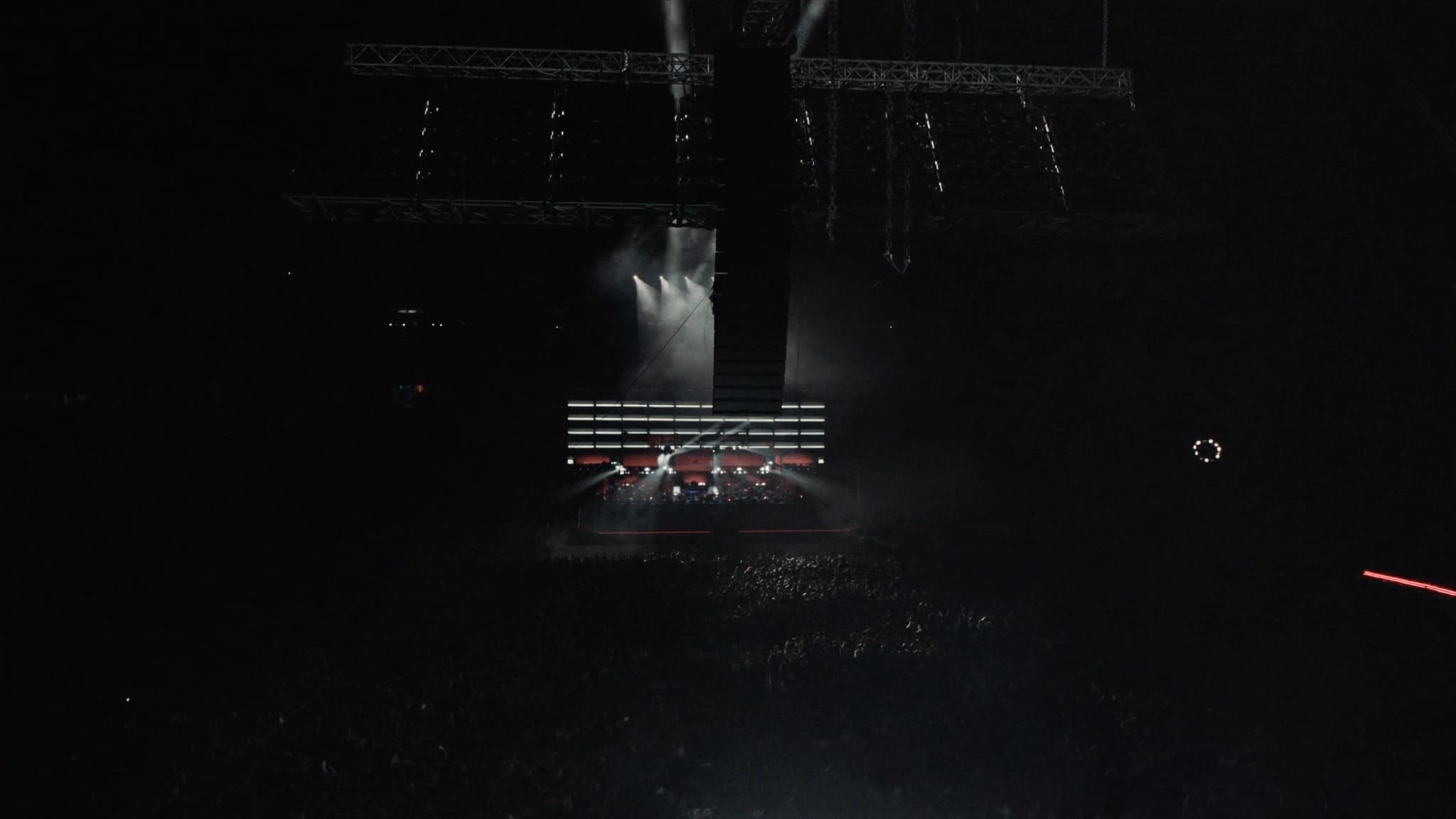
The first major choice in stadium sound design is between a single centre-hung cluster and a distributed system. A centre-hung array, suspended from the stadium roof at midfield, provides a single point source that can cover the entire seating bowl. However, this approach often struggles with near-field/far-field level differences and requires extremely long-throw cabinets to reach upper decks. SSOUNDS long-throw line arrays are engineered with high-efficiency drivers and precision waveguides to maintain pattern control over distances exceeding 100 metres, but even the best centre-hung system may leave shadow zones behind structural elements.

Distributed systems, using multiple smaller clusters hung around the perimeter of the roof or on trusses, offer superior coverage uniformity and intelligibility. By placing loudspeakers closer to the audience, each array covers a smaller area with less level variation. SSOUNDS compact line array modules are ideal for distributed deployments, providing consistent 100° horizontal coverage and vertical steering via DSP. The trade-off is increased complexity in alignment, delay, and rigging, but modern prediction software makes this manageable.

Delay Rings: Synchronising Sound Across the Bowl

In any large stadium, the speed of sound creates a noticeable time offset between the main PA and distant seats. Delay rings—secondary clusters positioned at intermediate distances—solve this by introducing electronic delay so that sound from the nearest array arrives at the same time as sound from the main cluster. SSOUNDS DSP platforms allow precise delay settings down to 0.1 ms, ensuring coherent wavefronts across the entire venue.

Proper delay ring placement requires careful acoustic modelling. SSOUNDS engineers use predictive simulation to calculate optimal locations, typically at the transition point between lower and upper tiers. Each ring is tuned to cover its zone without overlapping destructively with adjacent arrays. The result is a seamless soundfield where announcements and music remain intelligible from field level to the highest nosebleed seats.

Long-Throw Coverage and Pattern Control

Stadiums demand loudspeakers capable of projecting clear audio over extreme distances. SSOUNDS line arrays utilise proprietary horn designs and neodymium drivers to achieve high sensitivity and controlled directivity. The vertical curvature of the array is calculated to match the seating rake, while horizontal coverage is kept consistent to avoid spill into reflective surfaces.

For very long throws, such as covering the upper deck from a centre-hung position, SSOUNDS offers dedicated long-throw modules with larger compression drivers and optimised phase plugs. These cabinets deliver SPL levels exceeding 145 dB peak while maintaining low distortion. Pattern control is critical to avoid exciting reverberant modes in the stadium structure, and SSOUNDS arrays feature adjustable vertical splay angles to fine-tune coverage.

Intelligibility for Announcements and Music

Stadium sound systems must serve two primary functions: clear speech for emergency announcements and live commentary, and high-fidelity music reproduction for pre-game shows and halftime entertainment. Speech intelligibility is quantified by the Speech Transmission Index (STI), which should exceed 0.5 for acceptable clarity and 0.7 for excellent clarity. SSOUNDS systems achieve STI values above 0.6 even in challenging reverberant environments through careful array design and DSP equalisation.

For music, the system must reproduce low frequencies with authority while maintaining midrange clarity. SSOUNDS subwoofer arrays, deployed as cardioid or end-fire configurations, provide tight, controlled bass without muddying the mix. The full-range cabinets use coaxial or dual-concentric driver arrangements to ensure coherent phase response, essential for music reproduction at high levels.

Weatherproofing and Environmental Durability

Stadium loudspeakers are exposed to rain, dust, extreme temperatures, and UV radiation. SSOUNDS enclosures are constructed from marine-grade birch plywood or aluminium, coated with weather-resistant polyurea finishes. All drivers are treated with moisture-repellent coatings, and input panels are sealed with gaskets and covered by weather caps. For outdoor stadiums, SSOUNDS offers IP55-rated versions of its line array modules, ensuring reliable operation in tropical climates or winter conditions.

Rigging hardware is stainless steel and rated for seismic loads. SSOUNDS also provides thermal management solutions for amplifier racks located in equipment rooms, with redundant cooling and remote monitoring via network control. These features ensure that the system performs consistently season after season, even in harsh environments.

System Integration and Control

Modern stadiums require networked audio distribution and remote system control. SSOUNDS amplifiers support Dante and AES67 for digital audio transport, allowing low-latency signal distribution over standard Ethernet. System monitoring via SSOUNDS proprietary software provides real-time status of each amplifier channel, driver impedance, and temperature, enabling predictive maintenance.

Integration with fire alarm systems and emergency voice evacuation is also critical. SSOUNDS systems can be configured with redundant signal paths and automatic failover, meeting EN 54 standards for life safety. For entertainment events, the system can be controlled via industry-standard consoles and show control protocols like grandMA or DMX, giving sound engineers full flexibility.

Frequently asked

What is the difference between a centre-hung and distributed line array system for a stadium?

A centre-hung system uses a single large cluster at midfield, which can cause uneven coverage and shadow zones. A distributed system uses multiple smaller arrays around the roof, providing more uniform SPL and better intelligibility, especially in large or irregularly shaped venues.

How do delay rings improve sound quality in a stadium?

Delay rings are secondary loudspeaker clusters placed at intermediate distances from the main array. They are electronically delayed so that sound from each cluster arrives at the listener at the same time as sound from the main PA, eliminating echo and improving clarity.

What SPL levels can SSOUNDS stadium systems achieve?

SSOUNDS long-throw line array modules can achieve peak SPL levels exceeding 145 dB at 1 metre, with continuous output suitable for covering the farthest seats in a large stadium while maintaining low distortion.

Are SSOUNDS loudspeakers weatherproof for outdoor stadiums?

Yes, SSOUNDS offers IP55-rated versions of its line array modules, with moisture-repellent driver coatings, sealed input panels, and corrosion-resistant hardware, ensuring reliable operation in rain, dust, and extreme temperatures.

Can SSOUNDS systems integrate with existing stadium infrastructure?

Absolutely. SSOUNDS amplifiers support Dante and AES67 for digital audio networking, and the system can be integrated with fire alarm, emergency voice evacuation, and show control systems via standard protocols.

Building or upgrading a system?

SSOUNDS engineers and manufactures professional PA worldwide — from a single room to stadium scale.

Talk to an engineer
Chat on WhatsApp