The Best Speakers for Warehouses and Industrial Spaces
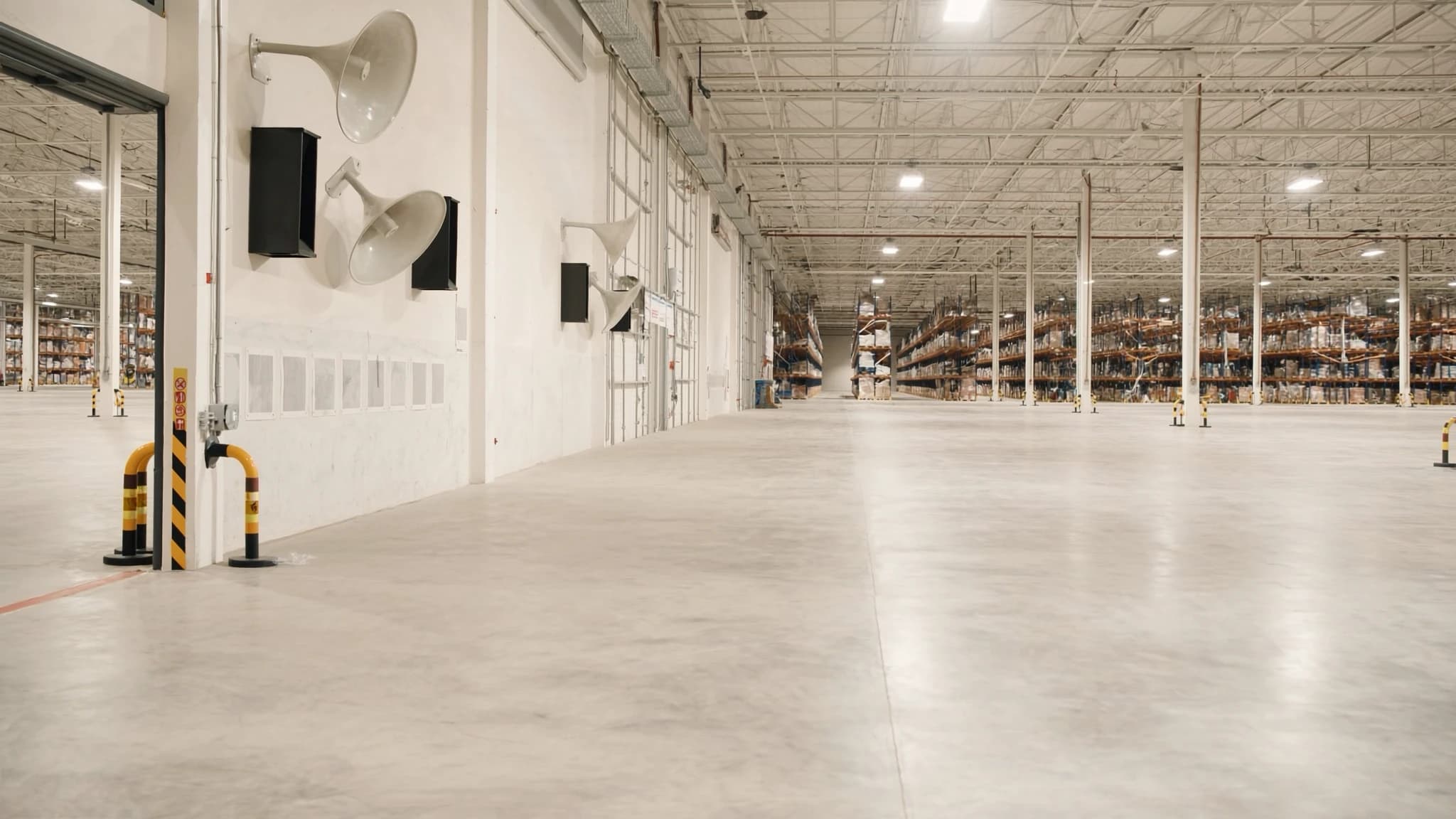
Choosing the right speakers for warehouses and industrial spaces is a unique challenge: high ceilings, constant background noise from machinery, and large open volumes demand a completely different approach than a typical venue. SSOUNDS engineers have designed systems for these environments, focusing on high-output 100V line speakers, horn-loaded pendants, and IP-rated hardware that withstands dust and humidity. This guide covers the key technical considerations, intelligibility over machinery, coverage strategy for big volumes, and the trade-offs between paging and music, so you can deploy a reliable, clear-sounding PA system that cuts through the noise.
Key takeaways
- High-ceiling, noisy industrial spaces require horn-loaded or pendant 100V line speakers for efficient, intelligible sound.
- Prioritize speech intelligibility (STI >0.5) over music fidelity; use DSP to cut low frequencies and boost presence.
- Zone the space based on noise levels and function; space pendant speakers at intervals equal to mounting height.
- Use IP54/IP66 rated hardware to withstand dust, humidity, and temperature extremes.
- Design for 90 dB SPL at ear level with 6 dB headroom; model coverage with acoustic simulation software.
- Always include emergency voice evacuation compliance and battery backup for life safety.
Understanding the Acoustics of Industrial Spaces
Warehouses and industrial spaces are acoustically hostile: concrete floors, metal walls, and open trusses create massive reverberation and echo. High ceilings (often 20–40 feet) mean sound must travel long distances before reaching listeners, and machinery noise (fans, conveyors, forklifts) can easily exceed 85 dB SPL. The primary goal is speech intelligibility for safety announcements, paging, and emergency alerts, music playback is secondary but still important for morale or background ambiance.
In such environments, conventional ceiling speakers or small point-source boxes fail because they lack the directivity and output to overcome reverberation. The solution is to use high-efficiency, horn-loaded speakers that concentrate sound into a narrow beam, reducing reflections and improving clarity. SSOUNDS industrial-grade systems employ constant-directivity horns and 100V line transformers to deliver consistent SPL over long distances without excessive power loss.
Key Speaker Types for Warehouses: Horn/Pendant and 100V Line
The most effective speakers for high-ceiling industrial spaces are horn-loaded pendants and high-output 100V line speakers. Horn-loaded pendants (often called 're-entrant' or 'projector' horns) use a flared throat to efficiently couple the driver to the air, producing high SPL with minimal power. They are typically suspended from the ceiling on a pendant mount, aiming downward to cover aisles and work zones. SSOUNDS pendant horn systems are engineered to provide 120 dB peak SPL at 1 meter, with a narrow 60° x 40° coverage pattern that minimizes spill into unoccupied areas.
100V line speakers (also called constant-voltage systems) are standard for distributed audio in large spaces because they allow many speakers to be paralleled on a single amplifier channel without complex impedance calculations. Each speaker has a step-down transformer with multiple tap settings (e.g., 1.25W, 2.5W, 5W, 10W) so you can adjust volume per speaker. For warehouses, choose high-power taps (10W or 20W) for main zones and lower taps for break rooms or offices. SSOUNDS 100V line array pendants combine the efficiency of horn loading with the convenience of constant-voltage distribution, making them ideal for long cable runs in large facilities.
Prioritizing Intelligibility Over Music: Paging and Voice Alerts
In industrial settings, the primary function of a PA system is paging and emergency voice evacuation, not music reproduction. Speech intelligibility is measured by the Speech Transmission Index (STI), and a score above 0.5 is considered acceptable; above 0.7 is excellent. To achieve this, the system must deliver clear midrange frequencies (500 Hz to 4 kHz) where consonant sounds reside, while avoiding excessive low-frequency content that muddies speech in reverberant spaces.
SSOUNDS industrial speakers are voiced with a tailored frequency response that emphasizes vocal clarity, using DSP presets that roll off sub-100 Hz frequencies and apply a gentle presence boost around 2-3 kHz. For paging-only zones, a 100V horn speaker with a 5W tap is often sufficient. For zones that also play background music, a full-range pendant with a wider bandwidth (80 Hz–16 kHz) can be used, but always with a high-pass filter to reduce low-frequency buildup. The amplifier should include a built-in paging microphone input with ducking (music volume automatically lowers when paging occurs).
Coverage Strategy for Large Volumes: Zoning and Aiming
Covering a large industrial volume (e.g., 100,000 sq ft with 30 ft ceilings) requires careful zoning and speaker placement. A single speaker cannot cover the entire space, you need a grid of pendants spaced 20–40 feet apart, depending on ceiling height and desired SPL. The rule of thumb: for pendant horns, the coverage diameter at ear level (5 ft above floor) is roughly equal to the mounting height. So a speaker at 30 ft will cover a 30 ft diameter circle, meaning you need a speaker every 30 ft in a hexagonal pattern for seamless coverage.
SSOUNDS recommends dividing the space into acoustic zones based on function: high-noise areas (loading docks, machine shops) need higher SPL and more speakers per square foot; quieter areas (storage, offices) need fewer. Use a 100V line amplifier with multiple output channels (e.g., 4 or 8 zones) so you can adjust volume and EQ per zone. For very high ceilings (over 40 ft), consider using a cluster of two or three horn pendants aimed at different angles to cover a wider area without gaps. Always aim speakers downward at 45°–60° from vertical to maximize coverage and minimize reflections off the ceiling.
IP-Rated Hardware: Dust, Humidity, and Temperature Resistance
Industrial environments expose speakers to dust, moisture, temperature extremes, and even chemical vapors. Standard consumer or commercial speakers will fail quickly. SSOUNDS industrial speakers are built with IP54 or IP66 ratings, meaning they are dust-tight and protected against water jets (IP66) or splashing (IP54). The enclosures are made from UV-stabilized ABS or aluminum, with stainless steel hardware and sealed input covers. For cold storage or freezer warehouses, speakers must also operate down to -20°C, which requires special lubricants and rubber gaskets that don't become brittle.
Additionally, consider the amplifier placement: mount amplifiers in a climate-controlled equipment room or NEMA-rated enclosure. SSOUNDS offers rack-mount 100V amplifiers with built-in DSP, remote monitoring, and fault detection, critical for ensuring the system stays operational in harsh conditions. For outdoor loading docks or uncovered areas, use speakers with an IP66 rating and a weatherproof pendant kit that prevents water ingress through the cable entry.
System Design and Installation Best Practices
Start with an acoustic site survey: measure ceiling height, ambient noise levels (use a sound level meter), and identify reflective surfaces. Use EASE or similar software to model coverage and predict STI. For a typical warehouse, target 90 dB SPL at ear level with 6 dB headroom for paging. Choose 100V line speakers with taps set to deliver 90 dB at 1 meter with 1W (efficiency rating). For example, a speaker with 95 dB 1W/1m efficiency at 10W tap will produce 105 dB at 1m, enough to overcome 85 dB ambient noise with 20 dB of headroom.
Cable runs: use 14 AWG or thicker for distances over 200 ft to minimize voltage drop. Always use shielded twisted pair for microphone lines to avoid interference from machinery. Install a paging microphone with a push-to-talk button and a built-in chime or pre-announcement tone to grab attention. For emergency voice evacuation, the system must comply with local fire codes (e.g., UL 864, EN 54) and have battery backup. SSOUNDS can provide a complete system design including speaker layout, amplifier sizing, and DSP programming, contact our engineering team for a consultation.
Frequently asked
What is the difference between a horn speaker and a regular cone speaker for warehouses?
Horn speakers use a flared throat to couple the driver to the air, producing much higher efficiency (more SPL per watt) and narrower directivity than cone speakers. This makes them ideal for long-throw applications in high-ceiling spaces, as they concentrate sound into a beam that cuts through noise and reduces reverberation.
Can I use standard 8-ohm speakers in a warehouse with a 100V line system?
No, 8-ohm speakers are not compatible with 100V line systems unless you add a step-down transformer. 100V line systems are designed for distributed audio with many speakers on long cable runs; using 8-ohm speakers would require very thick cables and careful impedance matching. Use dedicated 100V line speakers with built-in transformers.
How many speakers do I need for a 50,000 sq ft warehouse with 25 ft ceilings?
Assuming pendant horn speakers with 95 dB 1W/1m efficiency and 90 dB target at ear level, you would need approximately one speaker every 25 ft (coverage diameter equals mounting height). For 50,000 sq ft, that's about 80 speakers in a hexagonal grid. However, zoning and ambient noise may adjust the count, consult a professional designer.
What IP rating is needed for a dusty warehouse?
For dusty environments (non-hazardous), IP54 (dust-protected and splash-proof) is sufficient. For areas with water hoses or outdoor exposure, use IP66 (dust-tight and protected against powerful water jets). For explosive dust (e.g., grain silos), you need ATEX or IECEx certified speakers.
How do I ensure paging is heard over loud machinery?
Use a paging microphone with a ducking feature that automatically lowers background music volume when paging. Set the paging level to be at least 10 dB above ambient noise. Also, use a pre-announcement chime or tone to alert listeners. For very loud zones (above 90 dB), consider visual alerts (strobes) as a backup.
Building or upgrading a system?
SSOUNDS engineers and manufactures professional PA worldwide, from a single room to stadium scale.