A house of worship is a hard room. The nave of a church, the prayer hall of a mosque and the sanctuary of a cathedral were built for the voice to carry, and they do: every syllable comes back off the stone, the plaster and the dome a moment after it left the loudspeaker, and buries the next one. The answer has been known for decades: put the loudspeakers close to the congregation, aim them at the people and not at the ceiling, and keep the energy off the hard surfaces. The hard part has always been getting power and signal to a loudspeaker on a wall that nobody is allowed to chase a cable into.
That is where Power over Ethernet changes the job. A single Cat cable, no thicker than a telephone wire, carries the audio as a Dante stream, the power under the IEEE 802.3 PoE standards, and the control. The amplifier and the processing live inside the loudspeaker. There is no amplifier rack in the vestry, no loudspeaker cable through the wall and no mains outlet behind the pulpit, only one small cable to a PoE switch that can sit anywhere on the network.
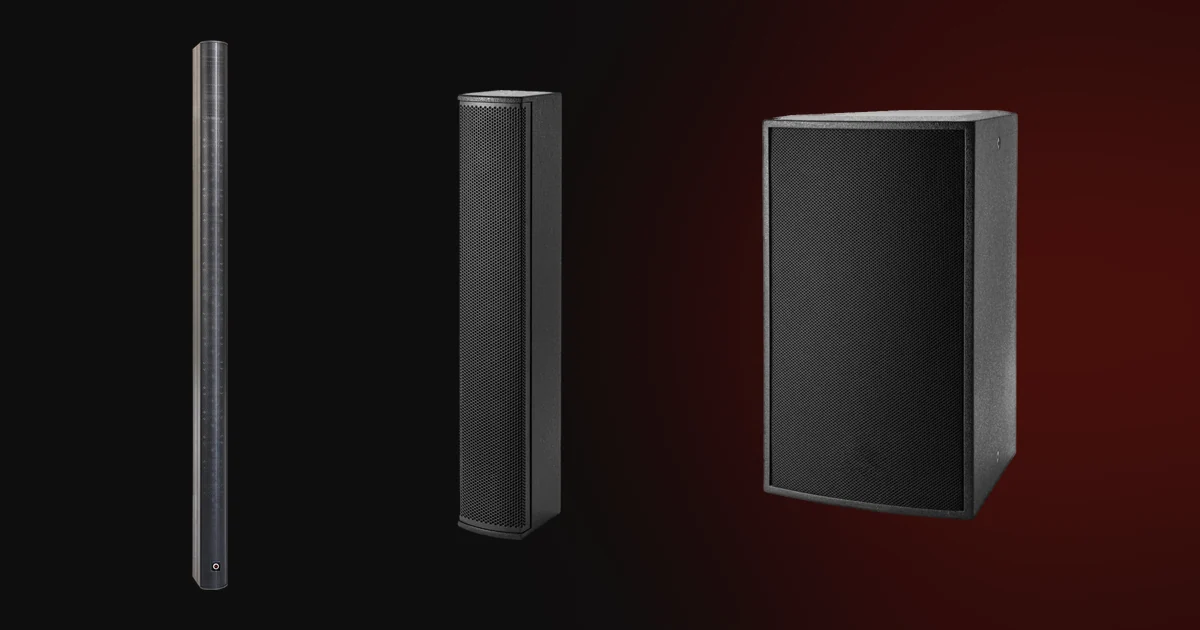
For a reverberant hall the loudspeaker to put on that cable is a column. The SSOUNDS LC4.3D and LC8.3D are self-powered column arrays: four or eight 3 inch full-range drivers in a vertical line, which holds the vertical pattern to 30 or 18 degrees while the horizontal stays 100 degrees wide. The sound lands on the seated congregation and much less of it reaches the ceiling, which is what makes the spoken word intelligible in a room that was never designed for it. Both run from PoE, PoE+ or PoE++, carry a built-in Class D amplifier and DSP, and report their status and temperature back over the network.
Where a fuller sound is wanted, for a worship band, a choir or a reading with music under it, the M-10D is a 10 inch two-way loudspeaker on the same single cable, reaching 51 Hz with 90 by 60 degree coverage, on a wall bracket or a base support. And for the rooms around the sanctuary, the foyer, the classrooms, the offices and the ablution areas of a mosque, the CL6HD and CL8HD are in-ceiling loudspeakers that take the same Dante stream and the same PoE power, so an announcement or the service itself reaches every room without a second system.
Network audio also solves a problem that is specific to worship: growth. A congregation adds an overflow room, a youth hall or a second service in a side chapel, and with a conventional system each one means a new amplifier channel and a new cable run back to the rack. On a Dante network it is a new loudspeaker on a new switch port, routed in software, and the operator at the desk sees it alongside everything else. A failing unit shows up on screen before Sunday morning or Friday prayer.
Not every room wants its loudspeakers powered from the network, and where the building already has amplification, or where the loudspeaker has to disappear completely, we specify a passive column. The LC8.2 and LC16.2 are aluminium columns only 65 mm wide that read as a line on a heritage wall rather than a cabinet, and the LC16.3 is the long straight column for airports, stations and the largest prayer halls. We design the system around the room, not the other way round.
If your church, mosque or cathedral is planning a new sound system, talk to our engineers about a design for your room, or read our guide to church sound system design and our mosque sound system design guide.