Fit out an office floor and the audio arrives last, after the IT contractor has finished: a small amplifier rack in the comms room, loudspeaker cable pulled to every ceiling speaker, a separate paging amplifier, and a control panel that nobody is quite sure how to use. It works, and it is also the only system in the building that does not run on the structured cabling the IT contractor certified a month earlier.
Power over Ethernet changes that. The office already has a Cat cable to every desk, every access point and every meeting room, and a PoE switch in the comms room powering the phones and the wireless. A PoE loudspeaker takes exactly the same cable. Down it come the audio, as a Dante stream, the power, under the IEEE 802.3 standards, and the control. The amplifier and the processing are inside the cabinet. There is no amplifier rack, no loudspeaker cable and no mains outlet above the ceiling tile.
For the facilities team this is the quiet part of the story. Zones are drawn in software: the open floor, the reception, each meeting room and the canteen take their own stream, and a room that is split by a partition next year is re-zoned with a patch lead and a few clicks. Paging and background music route to the rooms that should hear them and no others. Every loudspeaker reports its status and temperature to the network, so a fault shows on a screen before anyone walks round to find it. And the whole system is on the IT asset register, patched and documented like everything else on the switch.
The standards decide the switch budget. IEEE 802.3af delivers up to 15.4 W per port, 802.3at up to 30 W and 802.3bt up to 60 W or 90 W. Our network loudspeakers accept all three, and we specify PoE+ or PoE++ ports so the built-in amplifier has its headroom. Alongside Dante they are AES67 compliant, so they sit on a network with other audio-over-IP equipment, and their control runs over AES70.
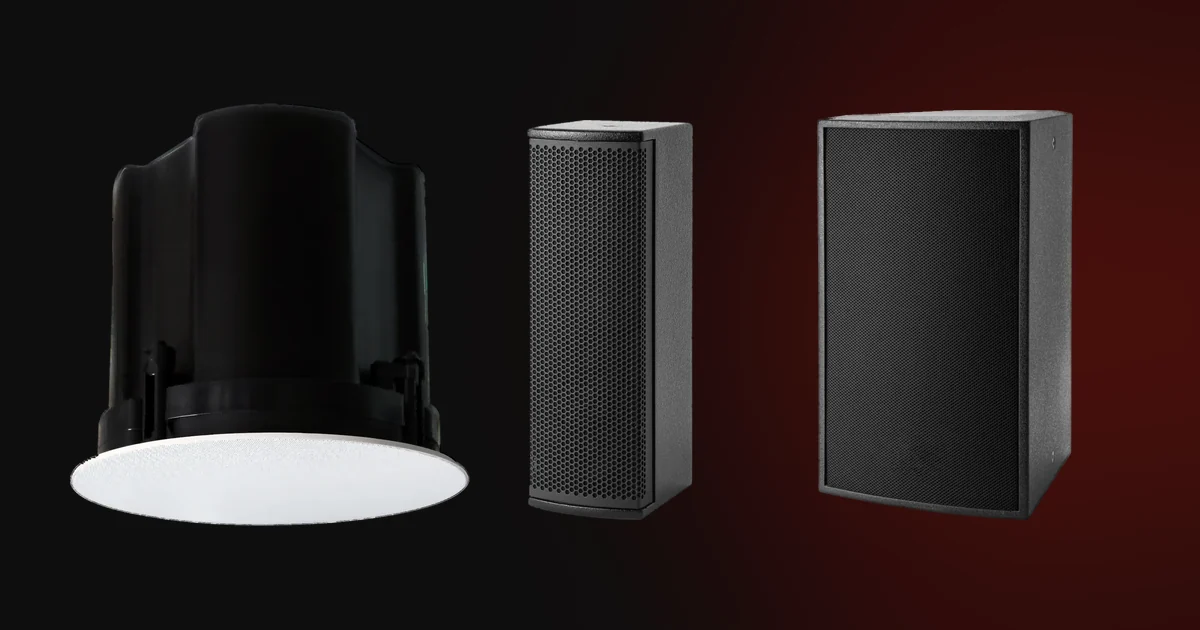
In the ceiling the CL6HD and CL8HD cover the open floor, corridors, reception and canteen: a two-way 6.5 inch or 8 inch in-ceiling loudspeaker with its own Class D amplifier and DSP, 90 by 90 degree coverage and one RJ45 on the back. For a boardroom or a meeting room with a hard ceiling, the LC4.3D is a self-powered column on the wall, four 3 inch drivers that keep speech on the table and off the glass. And for the town-hall room, the lecture theatre or the all-hands space, the M-10D is a 10 inch two-way loudspeaker on the same single cable, reaching 51 Hz for a presentation with music under it.
If you are fitting out a floor or a whole building, talk to our engineers about a network audio design that your IT contractor can install, or read our guide to Dante in audio for the detail behind the cable.